
Table of Contents
- Why Commercial Rodent Cleanup Services in California Are Different From Residential Jobs
- Signs You Need Professional Rodent Droppings Decontamination Services
- What Affects the Cost of Professional Attic Cleanup
- OSHA Requirements for Rodent Waste Cleanup on Commercial Properties
- The Professional Rodent Sanitation and Decontamination Process
- DIY vs. Professional Rodent Cleanup: What Property Managers Should Know
- Insurance, Home Value, and Energy Savings: The ROI of Commercial Rodent Cleanup
- Frequently Asked Questions
Last Updated: September 15, 2026
Why Commercial Rodent Cleanup Services in California Are Different From Residential Jobs
Commercial rodent cleanup services in California handle contamination at a scale that residential jobs rarely approach. A single-family attic might hold one nest and a few dozen droppings. A warehouse, restaurant row, or multi-unit apartment building can carry rodent waste across thousands of square feet of shared ductwork, ceiling plenums, and storage areas, which turns a cleaning job into a building-wide air quality problem. This guide from Rodent cleanup experts walks through what commercial property managers actually face: the health risks, the real cost drivers, and how to verify that a remediation crew did the job properly.
The core difference comes down to shared air. In a commercial building, contaminated insulation in one ceiling cavity feeds the same HVAC system that serves every tenant below it.
Skipping professional decontamination in a shared-air commercial building can spread rodent-borne pathogens through the entire ventilation system, turning a localized infestation into a building-wide health complaint.
Health Risks of Attic and Crawl Space Contamination
Rodent droppings and urine carry pathogens that become airborne when disturbed. Two of the most serious are hantavirus and histoplasmosis, both linked to inhaling contaminated dust rather than touching it directly. The CDC guidance on rodent-borne diseases explains that sweeping or vacuuming dry droppings with standard equipment is one of the most common ways people expose themselves. In commercial settings, that risk multiplies because contaminated dust can travel through shared ductwork into occupied spaces.
How Rodent Infestations Damage HVAC, Wiring, and Insulation
Rodents gnaw through wire insulation, nest inside HVAC components, and compress blown-in insulation until it loses its R-value. Once insulation settles and absorbs urine, it stops performing as a thermal barrier and starts acting as a reservoir for odor and allergens. Air sealing and vapor barrier integrity often fail at the same time, which is why HVAC efficiency drops alongside indoor air quality.
Signs You Need Professional Rodent Droppings Decontamination Services
Professional rodent droppings decontamination services are warranted the moment you find droppings in insulation, ductwork, or wall cavities, not just on visible surfaces. Three or more of the following signs typically mean a DIY approach will not be enough:
- Persistent musty or ammonia-like odor in multiple rooms
- Visible droppings or urine staining near insulation or HVAC vents
- Unexplained allergy symptoms among tenants or staff
- Chewed wiring, nesting material, or gnaw marks in ceiling cavities
- Rising energy bills with no change in usage patterns
- Insulation that looks compressed, stained, or displaced
If you notice any combination of these, a professional inspection is the logical next step.
What Affects the Cost of Professional Attic Cleanup
There is no flat rate for commercial attic cleanup, and any provider who quotes one over the phone is guessing. Pricing tracks the actual scope of work, which is why every reputable provider inspects before quoting. Understanding what drives scope helps property managers compare bids apples-to-apples instead of chasing the lowest number.
The biggest cost drivers, in rough order of impact:
- Total contaminated area (square feet). A 4,000-square-foot warehouse ceiling plenum is not four times the work of a 1,000-square-foot one, it is often more, because containment, negative air pressure, and disposal scale non-linearly.
- Insulation type and volume. Blown-in cellulose and fiberglass are removed differently than batt insulation, and some attics carry both. Removal volume, not just area, sets the labor hours.
- Access and height. A walk-in attic with a full stair is a different job than a crawl space reached through a 24-inch hatch, or a commercial plenum with no permanent access at all. Crews may need to cut and later restore access panels.
- HVAC and ductwork contamination. If rodent waste reached the ducts, the ducts must be cleaned or replaced, and that work is often subcontracted to a duct specialist, a line item that surprises managers who assumed ‘attic cleaning’ covered it.
- Odor and pheromone treatment. Urine soaks into framing and subfloor. Surface sanitizing does not neutralize it; enzyme or pheromone treatments do, and severe cases require multiple applications.
- Insulation replacement and air sealing. Removal is only half the job. New insulation, vapor barrier repair, and air sealing around penetrations add material and labor.
- Disposal and manifesting. Contaminated insulation is bagged, hauled, and documented. Disposal fees and manifest paperwork are real line items, not overhead.
How to compare bids without a price sheet. Ask each contractor to itemize by phase, containment, removal, HEPA cleaning, sanitization, exclusion, insulation replacement, disposal, and to state what is not included. The bid that looks cheapest usually excludes duct cleaning, insulation replacement, or disposal. The bid that looks expensive usually bundles work the cheap bid will bill later as a change order. Compare scope, not totals.
Ask for the itemized scope in writing before you sign. A provider who will not break down phases is either padding the number or planning to add one.
For an accurate figure on your building, request an on-site assessment. Phone estimates are marketing, not pricing.
OSHA Requirements for Rodent Waste Cleanup on Commercial Properties
OSHA requirements for rodent waste cleanup on commercial properties fall under general industry standards for hazardous waste and respiratory protection. Employers must assess workplace hazards, provide appropriate personal protective equipment, and train workers who handle biohazard cleanup.
The Professional Rodent Sanitation and Decontamination Process
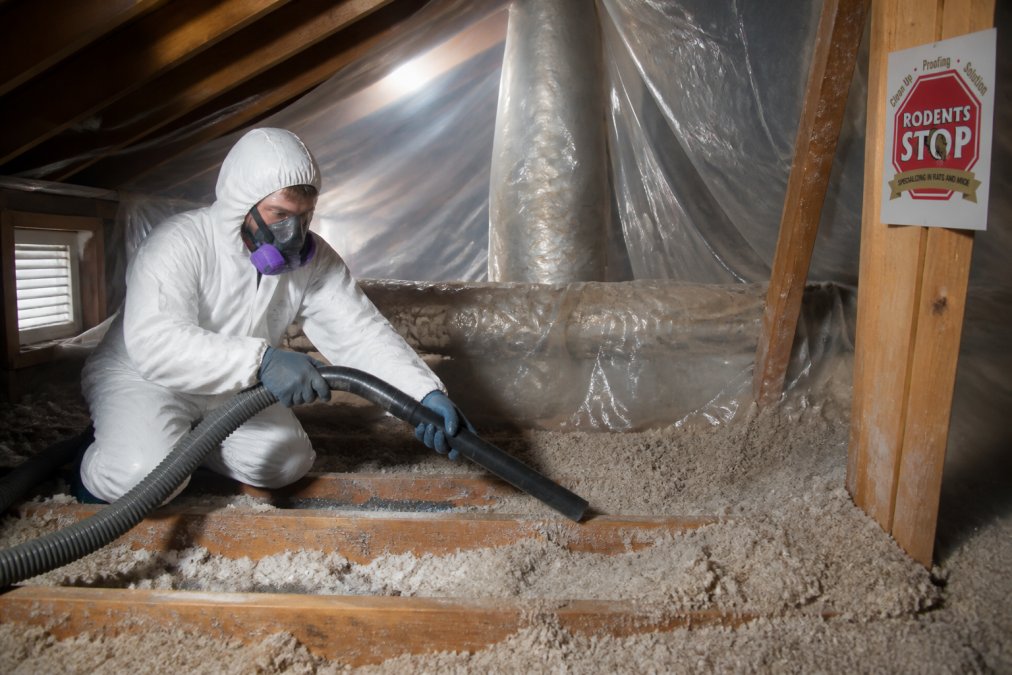
Insulation Removal, HEPA Filtration, and Biohazard Cleanup
Pest Exclusion and Air Sealing to Prevent Reinfestation
| Phase | What Happens | Why It Matters |
|---|---|---|
| Containment | Plastic sheeting, negative air pressure | Stops cross-contamination |
| Removal | Contaminated insulation extracted | Eliminates the odor source |
| HEPA cleaning | Surfaces vacuumed and scrubbed | Removes fine particles |
| Sanitization | Antimicrobial treatment applied | Kills remaining pathogens |
| Exclusion | Entry points sealed | Prevents reinfestation |
DIY vs. Professional Rodent Cleanup: What Property Managers Should Know
Insurance, Home Value, and Energy Savings: The ROI of Commercial Rodent Cleanup
Energy savings: what actually changes
Insurance: documentation is the claim
Property value and tenant retention
Where the old insulation goes
The ROI of commercial rodent cleanup is not a single payback figure. It is the sum of lower energy load, a defensible insurance claim, protected resale value, and avoided tenant liability, all of which require the same documentation packet.
Frequently Asked Questions
How much does commercial rodent cleanup cost in California?
The cost of professional attic cleanup depends on the square footage affected, the type of insulation (blown-in vs. batt), the severity of contamination, and whether mold remediation or structural repairs are needed. Commercial properties with multiple buildings or large crawl spaces will cost more than a single-family home. Because every infestation is different, most providers inspect the property first and provide a written quote. Request a detailed estimate that itemizes insulation removal, sanitization, and pest exclusion separately.
What are the OSHA requirements for rodent waste cleanup?
OSHA does not have a single standard for rodent waste, but several rules apply. The Bloodborne Pathogens standard (29 CFR 1910.1030) covers potential exposure to hantavirus and other pathogens in droppings and nesting materials. The Respiratory Protection standard (29 CFR 1910.134) requires fit-tested respirators when workers may inhale aerosolized contaminants. The Hazard Communication standard (29 CFR 1910.1200) requires labeling and training for any chemicals used. Employers must also provide PPE, training, and medical evaluations where exposure is possible.
How do I know if I need professional rodent droppings decontamination services or just a regular cleaning?
Standard janitorial cleaning does not address the health hazards rodents leave behind. If you see droppings, smell a persistent musky odor, find nesting materials in insulation, or notice staining on ceiling tiles, you need professional decontamination. Rodent droppings can carry hantavirus and other pathogens, and disturbing them with a regular vacuum spreads contaminated dust through the building. Professional rodent droppings decontamination services use HEPA filtration, hospital-grade disinfectants, and proper biohazard disposal to remove the contamination safely.
Can the odor come back after professional treatment?
Odor returns when the source is not fully removed. Droppings, urine-soaked insulation, and nesting materials in wall cavities or under floors will keep off-gassing until they are physically removed. Professional treatment includes removal of contaminated materials, HEPA vacuuming, enzyme-based odor neutralization, and pheromone treatment to discourage re-entry. If a provider only sprays a deodorizer without removing the source, the smell will return within weeks. Ask for a written scope that includes insulation removal and sanitization, not just fogging.
How do you find and seal rodent entry points during commercial rodent cleanup?
A thorough inspection identifies gaps around pipes, vents, roof lines, foundation cracks, and utility penetrations. Technicians use exclusion materials such as copper mesh, hardware cloth, and sealants rated for the application. Pest exclusion is not the same as pest control: pest control removes the animals, while exclusion prevents them from returning. Ask your provider for a written exclusion report with photos of each sealed entry point so you can verify the work and schedule follow-up inspections.
How long does a commercial rodent cleanup take?
Most single-family attic cleanups take one to two days. Commercial properties with multiple units, large crawl spaces, or heavy contamination can take three to five days or longer, especially if insulation removal and replacement are involved. The timeline depends on square footage, access, the amount of contaminated material, and whether mold remediation is needed. Ask for a project schedule in writing before work begins so you can plan around tenant access and business operations.
Does rodent damage affect property insurance claims or home value?
Most standard homeowners and commercial property policies exclude rodent damage, so cleanup is often an out-of-pocket expense. Document the infestation with photos, keep all invoices, and check whether your policy has any limited coverage for resulting damage. For resale, undisclosed rodent contamination can surface during inspection and reduce offers. A documented professional remediation with a warranty gives buyers and tenants confidence that the issue was addressed correctly.