Table of Contents
- Health Risks of Rat Urine in Your Home
- Protective Gear You Need Before You Start
- Preparation and Ventilation Before Cleaning
- Best Way to Clean Rat Urine: Step-by-Step Process
- Rodent Urine Odor Removal Products That Actually Work
- How to Sanitize an Attic After Rat Infestation
- Common Mistakes to Avoid When You Clean Rat Urine
- Conclusion
Last Updated: August 22, 2026
Rat urine is more dangerous than most homeowners realize, and the cleanup process is far less forgiving than a quick wipe-down with bleach. The best way to clean rat urine requires proper protective gear, the right disinfectant protocol, and a systematic approach that eliminates pathogens without spreading them further. This guide from Rodent Cleanup Experts walks through every step of safe, effective rodent urine sanitation, including surface-specific techniques and odor removal strategies that most generic guides skip entirely.
The real danger isn’t the smell. It’s what you can’t see.
Health Risks of Rat Urine in Your Home
Rat urine is a biohazard containing pathogens capable of causing serious illness. Contaminated surfaces, nesting materials, and dried urine residue can remain infectious for days to weeks depending on temperature and humidity.
Hantavirus and Other Pathogens
Hantavirus is the most serious disease associated with rodent urine and droppings. According to the CDC Hantavirus information page, hantavirus pulmonary syndrome carries a significant fatality rate, and deer mice are the primary carrier in North America. Rat urine can also transmit leptospirosis, a bacterial infection affecting the kidneys and liver, as well as salmonella and other bacterial pathogens through contact with contaminated surfaces.
Why Aerosolization Is the Real Danger
Aerosolization occurs when dried rodent urine and droppings become airborne particles when disturbed. Sweeping, dry dusting, or vacuuming with a standard vacuum are genuinely dangerous approaches. The moment you disturb dried urine stains or nesting materials without proper respiratory protection, you’re potentially inhaling infectious particles directly into your lungs.
According to EPA guidance on rodent-borne diseases and cleanup, opening windows and airing out a space for at least 30 minutes before entering is a critical first step that most DIY cleaners skip entirely.
Protective Gear You Need Before You Start
No cleanup should begin without the right personal protective equipment. This isn’t optional caution, it’s the baseline minimum for safe contact with contaminated surfaces.
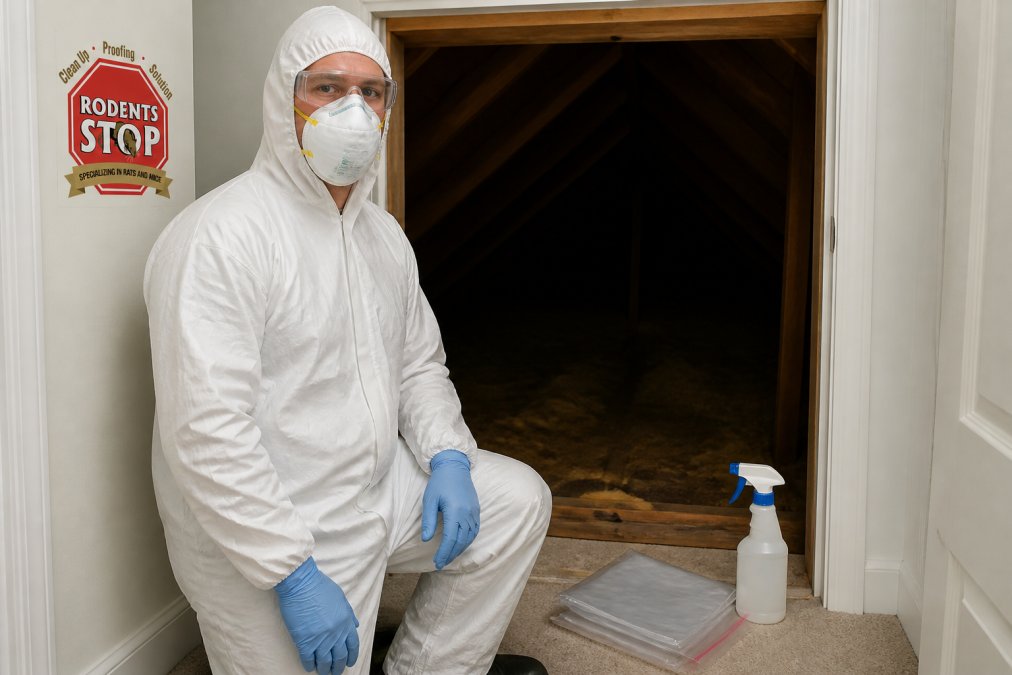
Required protective gear includes:
- Respirator mask: At minimum, an N95 respirator. For attic cleanups or large-scale infestations, a half-face respirator with P100 filters provides better protection.
- Rubber gloves: Heavy-duty rubber or nitrile gloves, not thin latex. Double-gloving is reasonable for heavy contamination.
- Eye protection: Safety goggles that seal around the eyes to block airborne particles.
- Disposable coveralls: A Tyvek suit or disposable coveralls prevent contamination from transferring to your clothing.
- Shoe covers: Especially important when moving between contaminated areas and living spaces.
Put all gear on before entering the contaminated space and remove it carefully when exiting.
Preparation and Ventilation Before Cleaning
Before opening a single bottle of disinfectant, the space needs to breathe. Cross-contamination is one of the most common and costly mistakes in DIY rodent cleanup.
Open all accessible windows and doors in the affected area and allow at least 30 minutes of ventilation before entering. For attics and crawl spaces with limited airflow, use a box fan directed outward to draw air through the space. Do not run your HVAC system during this process, as ductwork may already be contaminated and could spread particles throughout the house.
Remove any items from the area that don’t need to be cleaned on-site and seal them in plastic bags. Clear a path to the most heavily contaminated zones so you’re not disturbing additional surfaces unnecessarily.
Never sweep or vacuum rat droppings or dried urine with a standard household vacuum. Both actions aerosolize pathogens and distribute them through the air and across surfaces you haven’t yet treated. This is the single most dangerous mistake in DIY rodent cleanup.
Best Way to Clean Rat Urine: Step-by-Step Process
The best way to clean rat urine follows a specific sequence: disinfect first, then remove, then sanitize again. Skipping ahead or reversing steps defeats the purpose of decontamination.
Disinfectant Solution Preparation and Bleach Dilution Ratio
The standard EPA-registered disinfectant for rodent cleanup is a diluted household bleach solution. The correct bleach dilution ratio is 1.5 cups of household bleach per gallon of water, or approximately 1 part bleach to 10 parts water. This concentration is effective against hantavirus and most other pathogens found in rodent urine. Use this solution fresh, as bleach loses effectiveness when diluted solutions sit for more than a few hours.
Alternatively, EPA-registered commercial disinfectants labeled as effective against hantavirus are acceptable substitutes.
Cleaning Non-Porous vs. Porous Surfaces
The surface type changes everything about how you approach the cleanup.
Non-porous surfaces (concrete, tile, sealed wood, metal, glass):
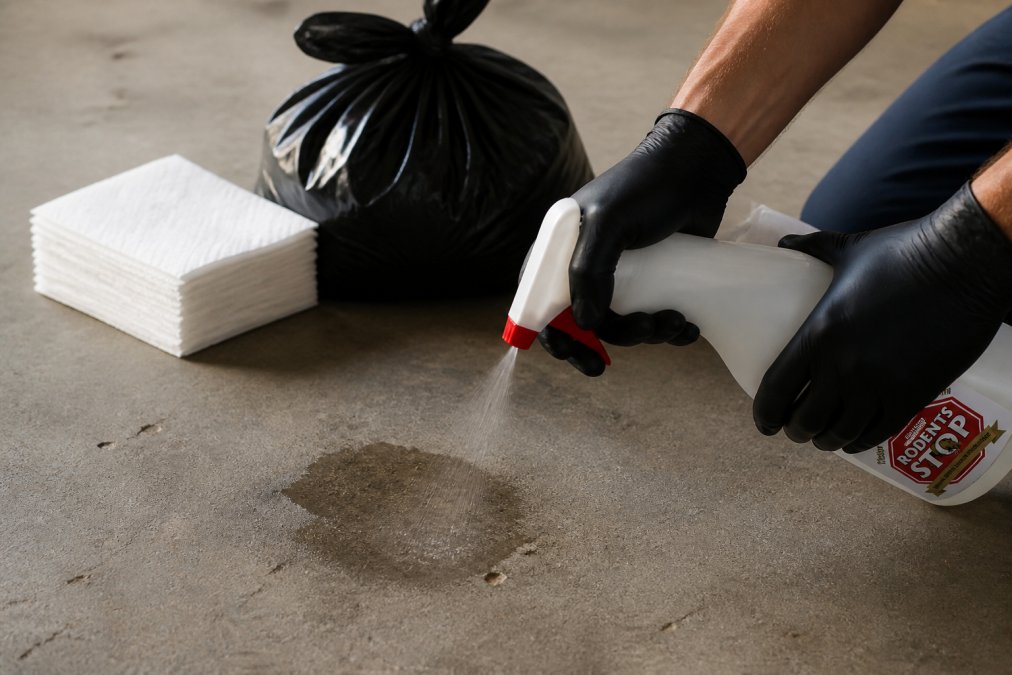
- Spray the disinfectant solution generously over the contaminated area.
- Allow a soaking time of at least 5 minutes. This dwell time is what actually kills pathogens.
- Use paper towels to wipe up the soaked area, working from outside edges inward.
- Apply a second application of disinfectant and allow to air dry.
- Dispose of all paper towels immediately in a sealed disposable bag.
Porous surfaces (wood without sealant, drywall, carpet, fabric, insulation):
Porous surfaces cannot be fully decontaminated with surface-level disinfectant application. Urine soaks below the surface where bleach solution cannot reach. Contaminated insulation, carpet, and unsealed wood must typically be removed and disposed of rather than cleaned in place.
| Surface Type | Disinfectant Effective? | Recommended Action |
|---|---|---|
| Concrete (unsealed) | Partially | Disinfect, assess depth of saturation |
| Sealed concrete/tile | Yes | Spray, dwell 5 min, wipe, repeat |
| Hardwood (unsealed) | No | Remove and replace |
| Drywall | No | Remove and replace |
| Carpet/fabric | No | Remove and replace |
| Metal/glass | Yes | Spray, dwell 5 min, wipe |
| Attic insulation | No | Remove and replace |
Safe Disposal of Contaminated Materials
All contaminated materials, including paper towels, gloves, nesting materials, and any removed insulation or debris, must be sealed in heavy-duty plastic bags before removal. Double-bag everything and seal each bag with tape before placing it inside the second bag.
For large-scale items such as contaminated insulation batts, place bags directly into outdoor trash containers. Do not carry open bags through living areas. Contact your local waste management provider about disposal requirements for biohazard materials.
For large-scale disposals involving multiple bags of contaminated insulation, contractor-grade disposal bags rated for biohazard material are significantly more durable than standard garbage bags and reduce the risk of tears during transport.
Rodent Urine Odor Removal Products That Actually Work
Cleaning surfaces removes the health hazard. Removing the odor requires a separate approach entirely.
Enzymatic Cleaners vs. Bleach for Odor
Bleach disinfects but does not eliminate the organic compounds responsible for rodent urine odor. Once the area is decontaminated with bleach solution, enzymatic cleaners are the appropriate next step for odor neutralization.
Enzymatic cleaners work by breaking down the uric acid crystals and organic proteins in rodent urine that cause persistent odor. They require adequate dwell time, typically 10 to 15 minutes of contact, and should not be mixed with bleach. Many homeowners report that bleach temporarily masks the smell but the odor returns within days because bleach oxidizes the surface without breaking down what’s underneath.
Odor Neutralization for Large-Scale or Porous Areas
For attic spaces, crawl spaces, or rooms with heavy contamination, surface-applied products alone are rarely sufficient. Effective approaches include:
- Contaminated insulation removal: The most reliable fix. Insulation acts as a sponge for rodent urine and cannot be treated in place effectively.
- HEPA vacuuming: After removal of bulk materials, HEPA vacuuming captures fine particles without aerosolizing them.
- Pheromone and odor treatment: Professional-grade products that neutralize rodent pheromones are important for odor control and to discourage re-infestation.
- Sealing porous surfaces: After decontamination, encapsulating treated surfaces with an appropriate sealant can lock in remaining odor compounds.
How to Sanitize an Attic After Rat Infestation
Knowing how to sanitize an attic after rat infestation is a different challenge from cleaning a hard floor. Attics concentrate contamination, have limited airflow, and typically contain large amounts of porous material that absorbs rodent waste.
Removing Nesting Materials and Contaminated Insulation
Nesting materials should be sprayed with disinfectant solution before being handled. Allow the solution to soak for at least 5 minutes, then use gloved hands to carefully place materials directly into disposal bags. Do not shake or compress nesting materials, as this releases particles.
Contaminated insulation, particularly blown-in insulation or fiberglass batts in areas with active rodent activity, generally requires full removal. Spot-treating insulation is not effective because urine saturation is often deeper and more widespread than visible staining suggests. According to National Pesticide Information Center guidance on rodent sanitation, full removal and replacement of contaminated insulation is the recommended standard for attic spaces with confirmed rodent infestation.
Post-Cleaning Monitoring and When to Call a Professional
After cleanup, watch for return of rodent odor within 2 to 4 weeks, new droppings in previously cleaned areas, signs of fresh nesting activity, or persistent musty smell that doesn’t respond to odor treatment. If any of these appear, the cleanup is incomplete or rodents have re-entered. A professional team can identify entry points, assess whether contamination extends beyond the initially cleaned area, and apply treatments that aren’t available through retail channels.
Common Mistakes to Avoid When You Clean Rat Urine
Most DIY failures come down to a handful of consistent errors.
Sweeping or vacuuming without a HEPA filter. Standard vacuums exhaust particles back into the air, aerosolizing pathogens across a larger area.
Skipping the dwell time. Spraying disinfectant and immediately wiping it up does almost nothing. The disinfectant needs 5 minutes minimum of contact time to actually kill pathogens.
Using bleach on porous surfaces and assuming the job is done. Bleach cannot penetrate porous materials deeply enough to decontaminate them. If contamination is more than superficial, removal is the only reliable option.
Not ventilating before entry. Entering a sealed attic or crawl space without first airing it out creates immediate exposure risk from aerosolized particles.
Cleaning without sealing entry points first. Cleaning a contaminated attic without addressing how rodents got in guarantees the problem returns. Sanitation and exclusion need to happen together.
The core principle of safe rodent urine cleanup is: disinfect before disturbing, remove rather than clean porous materials, and treat odor as a separate step from decontamination. Skipping any of these three steps turns a manageable cleanup into a recurring problem.
Rat urine cleanup done halfway is worse than no cleanup at all. It creates a false sense of safety while contamination remains. Rodent Cleanup Experts provides professional rodent infestation cleanup services across Los Angeles, Ventura, San Bernardino, Riverside, and Orange Counties, including contaminated insulation removal, HEPA vacuuming, deep sanitization, and pheromone treatment designed to eliminate both the health hazard and the odor. Get started with Rodent Cleanup Experts and restore your home to a genuinely clean, safe condition.
Frequently Asked Questions
How long does rat urine stay toxic?
Rat urine can remain a health hazard for days to weeks depending on conditions. In enclosed spaces like attics with poor ventilation, pathogens such as hantavirus can survive longer in dried urine and fecal matter. Humidity and temperature affect how quickly the material degrades. The CDC recommends treating any rodent contamination as potentially infectious regardless of how old it appears. Never assume dried urine is safe, always clean rat urine using proper disinfectant and protective gear.
Is it safe to vacuum rat urine or droppings?
Standard vacuuming is one of the most dangerous things you can do during rodent cleanup. A regular vacuum disperses dried particles into the air, dramatically increasing the risk of inhaling hantavirus and other pathogens through aerosolization. The CDC explicitly advises against sweeping or vacuuming rodent waste. If vacuuming is necessary for large-scale cleanup, only HEPA-filter vacuums rated for biohazard work should be used, and only by trained professionals wearing full respiratory protection.
What kills the smell of rat urine?
Bleach-based disinfectants kill the bacteria causing odor on non-porous surfaces, but the smell often persists because urine soaks into porous materials like wood, drywall, and insulation. EPA-registered enzymatic cleaners break down the uric acid compounds responsible for the lingering odor. For attic-scale infestations, contaminated insulation typically needs full removal since no surface product fully neutralizes odor once urine has saturated the material. Professional pheromone and odor treatments address what household products cannot.
What protective gear is needed for rodent cleanup?
At minimum, wear rubber gloves, a respirator mask rated N95 or higher, and eye protection before handling any contaminated materials. For attic or crawl space work where rodent infestation is confirmed, add a disposable Tyvek suit to prevent cross-contamination on clothing. Open-toed shoes or thin fabric footwear are not appropriate. After cleanup, remove gloves carefully to avoid touching your face, wash hands thoroughly, and bag all disposable gear before placing it in the trash.
This article was written using GrandRanker