Table of Contents
- What Drives the Cost of Professional Attic Cleanup
- Rodent Damage Attic Restoration Cost vs. Basic Cleaning
- Attic Insulation Removal and Replacement Price Breakdown
- The Attic Decontamination Process Explained
- Signs Your Attic Needs Professional Cleanup Now
- DIY vs. Professional Attic Cleanup: An Honest Comparison
- Does Homeowners Insurance Cover Attic Cleanup Costs?
- Conclusion
Last Updated: August 23, 2026
What Drives the Cost of Professional Attic Cleanup
The cost of professional attic cleanup varies widely because homeowners often compare fundamentally different services. Understanding what drives cost is essential to evaluating any quote accurately. The final price depends on two dominant variables: the physical size and accessibility of the attic, and the severity of contamination.
Below, we break down every factor that affects pricing, explain the difference between cleanup and full restoration, and give you a framework for making an informed decision.
Square Footage and Attic Access
Square footage is the baseline for almost every professional estimate. Larger attics require more labor hours, more materials for insulation removal and replacement, and more time for HEPA vacuuming and sanitization. A small attic under 500 square feet is fundamentally different from a 2,000-square-foot attic.
Access matters just as much as size. Attics with a standard pull-down staircase are straightforward. Attics with a single small hatch, low clearance, or structural obstacles require technicians to work in cramped conditions, and that labor intensity is reflected in the quote. Crawl spaces often command higher labor costs per square foot than open attics.
When requesting an estimate, ask the contractor whether their price-per-square-foot calculation accounts for access difficulty. An open attic and a tight crawl space are not priced the same way, even at identical square footage.
Contamination Level and Type of Infestation
A light rodent presence with a few droppings requires a different response than a long-term infestation with heavily saturated insulation and extensive contamination. Contamination level is the single biggest variable that separates basic cleanup from full decontamination.
The type of pest also matters. Rat infestations tend to produce more structural damage and concentrated contamination than mice infestations. Rodents living in an attic for months compromise insulation R-value, leave urine trails throughout, and potentially damage HVAC ducts and wiring. That scope requires hazardous materials protocols.
Rodent Damage Attic Restoration Cost vs. Basic Cleaning
Most homeowners don’t realize they’re asking for two completely different services when they call for attic cleanup.
Attic restoration is comprehensive: contaminated insulation removal, HEPA vacuuming of all surfaces, sanitization and disinfectant fogging, odor and pheromone treatment, air sealing of entry points, and replacement of insulation to restore the attic’s original R-value. It addresses structural integrity concerns and leaves the attic in better condition than before the infestation.
Basic attic cleaning typically means removal of visible debris, nesting material, and accessible rodent droppings. It does not include insulation removal, decontamination of surfaces, or treatment for bacteria and allergens embedded in the structure.
The contamination level determines which service is appropriate. Choosing basic cleaning when full restoration is needed defers a larger problem.
Basic Cleanup vs. Full Restoration: What Each Includes
| Service Component | Basic Cleanup | Full Restoration |
|---|---|---|
| Droppings and debris removal | Yes | Yes |
| Nesting material removal | Yes | Yes |
| Contaminated insulation removal | No | Yes |
| HEPA vacuuming of surfaces | Partial | Full |
| Sanitization and disinfection | No | Yes |
| Disinfectant fogging | No | Yes |
| Odor and pheromone treatment | No | Yes |
| New insulation installation | No | Yes |
| Air sealing and entry point ID | No | Yes |
| Vapor barrier inspection | No | Sometimes |
If rodents have saturated insulation with urine, basic cleanup leaves active allergens, bacteria, and pheromones in place. Future rodents are attracted by those pheromone trails, and the infestation cycle repeats.
Attic Insulation Removal and Replacement Price Breakdown
Attic insulation removal and replacement is one of the largest cost components in a full restoration job. Contaminated insulation cannot be cleaned in place. Rodent urine and droppings penetrate batt and blown-in insulation deeply enough that surface sanitization is ineffective. Complete removal, disposal of hazardous materials, and fresh installation is the only compliant approach.
Pricing depends on square footage, insulation type, depth of existing insulation, and waste disposal fees for contaminated material. Disposal of biohazard-classified insulation requires appropriate containment and transport.
EPA guidance on rodent-contaminated insulation disposal
Batt vs. Blown-In Insulation Replacement
Batt insulation (fiberglass or mineral wool) comes in pre-cut panels and is easier to remove in sections, reducing labor time. However, removal still requires full respiratory protection and containment to prevent cross-contamination of living spaces.
Blown-in insulation (cellulose or fiberglass) is more complex to remove. It requires industrial vacuum equipment with HEPA filtration to extract material without dispersing contaminated particles through the attic and into the home’s air supply. The removal process takes longer and drives up labor costs.
Replacement insulation is specified by R-value, the thermal resistance rating that determines energy efficiency. Restoring an attic to its original R-value after a rodent infestation directly affects heating and cooling costs. According to the U.S. Department of Energy’s insulation recommendations, proper attic insulation R-values vary by climate zone.
Never allow a contractor to install new insulation over contaminated existing insulation. This traps active biohazards beneath fresh material and does not address odor, bacteria, or pheromone contamination. It will also void most insulation warranties.
The Attic Decontamination Process Explained
Attic decontamination is the systematic elimination of biological contaminants, rodent droppings, urine, nesting material, bacteria, and allergens from an attic space using professional-grade equipment and protocols. It treats surfaces at a microbial level to restore the space to a safe, sanitary condition.
The contamination level and square footage determine how long the process takes. A moderately affected attic might be completed in a single day. A severe, long-term infestation can take two to three days.
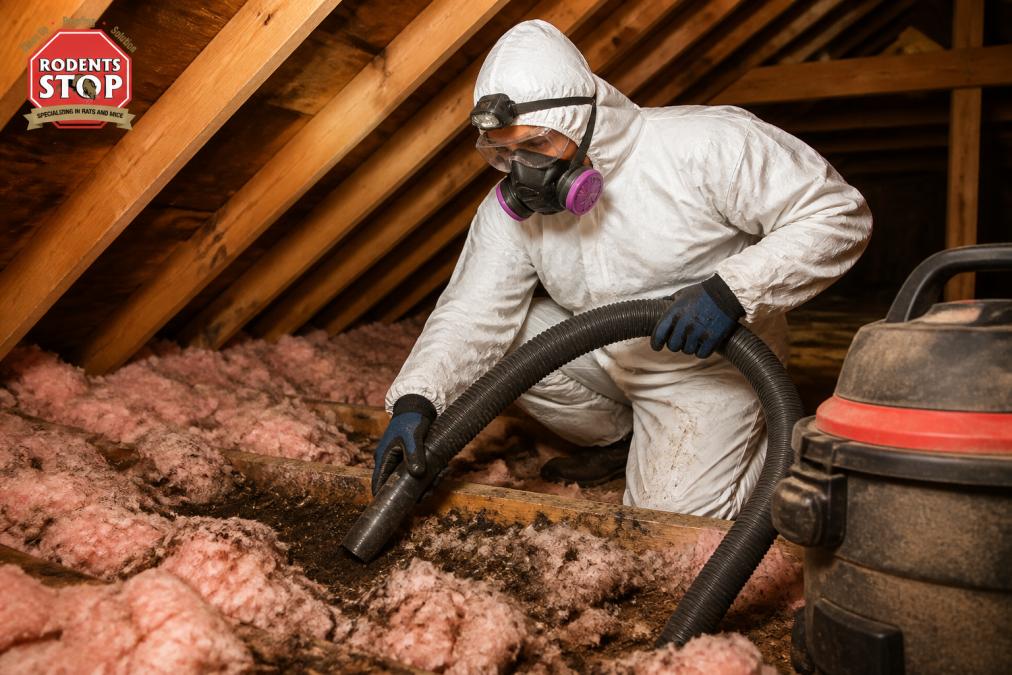
HEPA Vacuuming, Sanitization, and Disinfectant Fogging
The process follows a specific sequence. Skipping steps or changing the order compromises the result.
- Insulation removal, All affected batt or blown-in insulation is removed and bagged for disposal as hazardous materials
- Dry debris removal, Rodent droppings, nesting material, and solid waste are removed manually and by HEPA vacuum
- HEPA vacuuming of all surfaces, Every rafter, joist, and surface is vacuumed with HEPA-filtered equipment to capture fine particulate matter including dried urine crystals and fecal dust
- Sanitization, Antimicrobial agents are applied to all surfaces to eliminate bacteria and pathogens
- Disinfectant fogging, A fog treatment reaches areas that manual application cannot, including crevices and structural gaps
- Odor and pheromone treatment, Enzyme-based or oxidizing agents neutralize rodent pheromones that would otherwise attract new infestations
- Air sealing, Entry points identified during inspection are sealed to prevent re-entry
- Insulation replacement, New insulation is installed to the appropriate R-value
Equipment and PPE Requirements
Professional attic decontamination requires equipment and personal protective equipment that meet OSHA standards for biohazard work.
Equipment required:
- Industrial HEPA vacuum with sealed containment
- Insulation removal vacuum system for blown-in material
- Commercial-grade fogging equipment
- Containment barriers to prevent cross-contamination
PPE required:
- Full-face respirator with P100 filters rated for biological particulates
- Tyvek disposable suit (full body coverage)
- Nitrile gloves (double-layered)
- Boot covers
According to OSHA respiratory protection standards for biohazard environments, appropriate respiratory protection is mandatory when working with rodent-contaminated materials due to the risk of Hantavirus and other airborne pathogens.
Signs Your Attic Needs Professional Cleanup Now
Most homeowners discover a rodent problem later than they should. By the time visible signs appear, contamination is typically well-established.
Watch for these indicators:
- Rodent droppings along attic joists, near HVAC ducts, or around attic access points
- A persistent ammonia-like odor that intensifies in upper rooms
- Visible nesting material made from insulation, paper, or fabric
- Damaged or compressed batt insulation in localized areas
- Chewed wiring, duct tape, or HVAC components
- Increased energy bills without a clear cause
- Scratching or movement sounds in the attic, particularly at night
- Evidence of entry points: gaps in fascia, soffit damage, or gnaw marks near roof penetrations
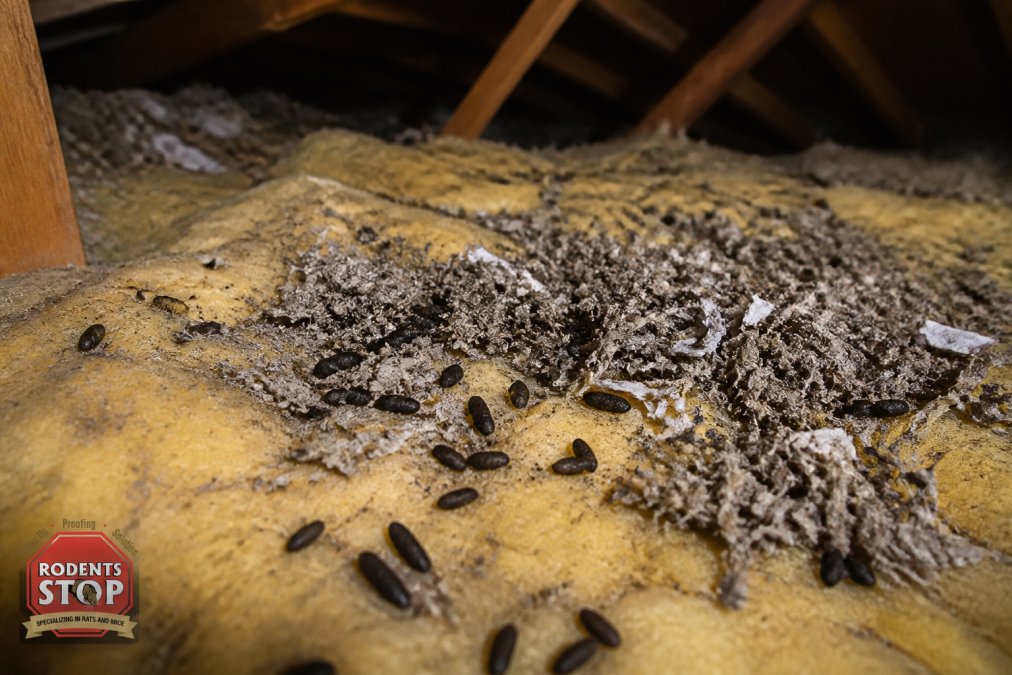
Any one of these signs warrants a professional inspection. Multiple signs together indicate an active or recent infestation that has likely progressed beyond what basic cleanup can address.
Attic odor that persists after basic cleaning is almost always a sign that contaminated insulation was left in place. Odor treatment without insulation removal is a temporary fix, not a solution.
DIY vs. Professional Attic Cleanup: An Honest Comparison
DIY attic cleanup is appropriate for minor, early-stage situations with no insulation contamination. It is not appropriate for anything involving significant rodent droppings, saturated insulation, or any suspicion of Hantavirus exposure risk.
A regular vacuum, even one with a HEPA filter, does not provide the sealed containment that professional HEPA systems use. Running a standard vacuum over rodent droppings aerosolizes dried fecal matter and urine crystals, distributing them through the air rather than capturing them. Bleach does not neutralize rodent pheromones, and it does not penetrate insulation.
| Factor | DIY Approach | Professional Service |
|---|---|---|
| Equipment capability | Consumer-grade, limited containment | Industrial HEPA, sealed systems |
| Biohazard handling | Not rated for rodent pathogens | OSHA-compliant protocols |
| Insulation removal | Impractical without proper equipment | Full removal and disposal |
| Odor/pheromone treatment | Bleach or store products (ineffective) | Enzyme/oxidizing agents |
| Entry point identification | Visual only, often incomplete | Systematic inspection |
| Health risk | Significant without proper PPE | Managed with professional PPE |
The cost of professional attic cleanup is higher upfront. The cost of a repeat infestation because pheromone trails were left in place is higher still.
Does Homeowners Insurance Cover Attic Cleanup Costs?
Standard homeowners insurance policies generally exclude damage caused by rodents, insects, and other pests. The reasoning is that pest infestations are considered a maintenance issue that develops over time and could be prevented. Sudden, accidental damage is covered; gradual contamination typically is not.
There are scenarios where coverage may apply. If rodents damaged electrical wiring and that damage caused a fire, the fire damage may be covered even if the underlying rodent damage is not. Some policies include limited coverage for sudden and accidental damage to HVAC systems, which rodents frequently target.
Document everything before cleanup begins. Photograph the contamination, insulation damage, entry points, and any structural or mechanical damage. Submit a claim and let your insurer make the determination. Some property owners in Los Angeles, Riverside, Ventura, Orange, and San Bernardino Counties have found that landlord insurance policies carry different terms than standard homeowner policies. Review your specific policy language or consult your insurance agent.
Post-Cleaning Maintenance to Protect Your Investment
A completed attic decontamination is a significant investment. Protecting it requires a maintenance schedule.
Recommended post-cleaning maintenance:
- 30 days post-service: Inspect all sealed entry points for signs of new gnaw marks
- Every 6 months: Walk the roofline and exterior perimeter to check for new gaps in fascia, soffit, vents, and roof penetrations
- Annually: Schedule a professional attic inspection to verify insulation integrity and confirm that air sealing remains intact
- After any roofing work: Re-inspect attic access points, as contractors frequently disturb sealed entry points
- After heavy rain seasons: Check for moisture intrusion that can degrade insulation
Attic ventilation also requires periodic attention. Blocked soffit vents create heat and moisture buildup that attracts pests and degrades insulation. Ensure attic ventilation is unobstructed as part of your annual inspection.
The goal is straightforward: catch a new problem at the early stage, when a basic inspection and minor sealing work is all that’s needed.
Rodent contamination in an attic does not improve with time. The longer contaminated insulation remains in place, the more embedded the odor, bacteria, and pheromone trails become, and the more likely a repeat infestation becomes. Rodent infestation cleanup from Rodent Cleanup Experts provides full-scope attic decontamination, insulation removal and replacement, sanitization, and entry point identification for homeowners and property managers throughout Los Angeles, Ventura, San Bernardino, Riverside, and Orange Counties. Get a professional inspection and service quote from Rodent Cleanup Experts and restore your attic to a clean, safe condition.
Frequently Asked Questions
Q: What is included in a professional attic cleanup service?
A: A professional attic cleanup typically includes removal of rodent droppings and nesting materials, contaminated insulation removal, HEPA vacuuming of all surfaces, sanitization with disinfectants, disinfectant fogging for odor and pheromone elimination, and a final inspection. Depending on damage severity, the service may also include air sealing, vapor barrier replacement, HVAC duct cleaning, and new insulation installation to restore the attic's R-value and energy efficiency.
Q: How much does it cost to remove rodent-contaminated insulation?
A: Attic insulation removal and replacement price varies based on square footage, insulation type (batt or blown-in), contamination level, and labor costs in your area. Because every infestation is different, most professional services require an on-site inspection before quoting. Factors like difficult attic access, extensive rodent damage, or the need for mold remediation can significantly affect the final figure. Contact a qualified provider for an accurate estimate based on your specific attic conditions.
Q: Does homeowners insurance cover attic cleanup after a rodent infestation?
A: Most standard homeowners insurance policies exclude damage caused by rodents, classifying it as a maintenance issue rather than a sudden covered peril. However, if a rodent infestation caused a secondary event, such as a fire from chewed wiring, that secondary damage may be covered. Review your policy's exclusions carefully and contact your insurer directly. Some policies offer add-on endorsements for pest-related damage. Always document the infestation thoroughly with photos before any cleanup begins.
Q: Why is professional attic decontamination necessary after a rodent infestation?
A: Rodent droppings, urine, and nesting materials carry bacteria, allergens, and pathogens including Hantavirus and Salmonella. A regular vacuum and household bleach will not fully eliminate these hazards or neutralize pheromone trails that attract new rodents. Professional attic decontamination uses HEPA vacuuming, biohazard-rated waste disposal, and disinfectant fogging to address contamination at a level that protects your household's health and reduces the risk of re-infestation.
This article was written using GrandRanker