Table of Contents
- Why Rats Keep Coming Back: The Pheromone Problem
- How to Clean Rat Droppings Safely
- The Best Way to Remove Rat Smell
- Enzymatic Cleaner for Rodent Urine: How It Works
- Natural vs. Chemical Repellents: What Actually Works
- Sealing Entry Points and Post-Cleanup Monitoring
- When to Call a Professional Rodent Cleanup Service
- Frequently Asked Questions
Last Updated: September 10, 2026
Why Rats Keep Coming Back: The Pheromone Problem
If you have cleaned up after rats only to watch new ones move in weeks later, the problem is not your cleaning technique, it is the chemical message the first infestation left behind. Learning how to neutralize rat pheromones is the step most homeowners skip, and why traps keep filling up long after the visible mess is gone.
Rat pheromones are chemical compounds rodents release in urine, droppings, and sebaceous gland secretions to communicate territory, reproductive status, and danger. These scent markers persist on surfaces long after the rodent is gone, acting as an invitation to every rat that passes through.
At Rodent cleanup experts, we see this constantly across Southern California attics and crawl spaces: a pest control company removes the animals, the homeowner wipes down the mess, and three months later the scratching starts again.
What Are Rat Pheromones and How Do They Work?
Rat pheromones are volatile organic compounds detected by the vomeronasal organ, a sensory structure separate from the nose. They fall into two groups: primer pheromones, which trigger physiological changes like reproductive timing, and releaser pheromones, which drive immediate responses such as attraction or alarm.
The chemistry is where most cleanup advice falls apart. Rat urine is not a simple liquid, it is a suspension of small volatile pheromone molecules riding on larger carrier proteins called major urinary proteins (MUPs). Those proteins are the reason the scent lasts. MUPs bind pheromone molecules in a pocket that slowly releases them over weeks and months, and they also cling tightly to porous surfaces through hydrogen bonding. A study in the Journal of Chemical Ecology on mammalian semiochemicals describes how urinary proteins carry pheromone molecules and slow their release over time, which is why the smell lingers for months.
Why Standard Household Cleaners Fail at the Molecular Level
This is the part almost no DIY guide explains, and why so many homeowners repeat the same cleanup three or four times.
- Soap and detergent lift oils and dirt but do not break peptide bonds. The MUP carrier survives, and so does the pheromone it holds.
- Bleach oxidizes bacteria and some surface proteins, but it does not penetrate the protein pocket where pheromones are stored. It also leaves behind uric acid crystals, a separate odor source that reactivates on humid days.
- Ammonia cleaners add their own strong scent on top of existing markers. To a rat, that reads as another animal’s territory claim, not a clean space.
- Air fresheners and ozone generators mask or oxidize airborne odor molecules but leave the surface-bound protein-pheromone complex untouched. The scent returns as soon as humidity rises.
What breaks the cycle is an enzymatic or bacterial treatment that produces proteases, enzymes that cleave the MUP protein itself. Once the carrier protein is digested, the pheromone has nothing to bind to and is degraded or rinsed away. That is the difference between masking a scent and neutralizing it at the source.
Scent Marking and Urine Trails: The Invisible Highway
Rats navigate by scent, not sight. A rat moving through a wall cavity deposits urine trails along its path, creating a scent highway for every rat that follows. These trails signal safety and familiarity, so new rodents read them as a green light.
The practical consequence: wiping surfaces with soap removes the visible stain but leaves the pheromone intact. New rats detect it immediately and treat your attic as occupied territory.
A quick field test: clean a small test patch with soap and water, let it dry, then clean an adjacent patch with an enzymatic cleaner. If the soap-only patch smells again after a humid day and the enzymatic patch does not, you have confirmed that protein-bound pheromones, not surface dirt, are driving the odor.
How to Clean Rat Droppings Safely
Cleaning rat droppings safely requires more than gloves and a trash bag. Rodent waste can carry pathogens including hantavirus, salmonella, and leptospirosis, and disturbing dried droppings releases contaminated dust into the air.
The CDC guidance on cleaning up after rodents recommends that anyone handling rodent waste wear protective equipment, avoid dry sweeping or vacuuming with standard equipment, and disinfect rather than simply remove.
Personal Protective Equipment (PPE) You Need
Before you touch anything, put on the following:
- N95 or P100 respirator to block aerosolized dust and viral particles
- Disposable nitrile gloves worn under a second pair for double protection
- Eye protection such as sealed goggles, not open safety glasses
- Disposable coveralls if you are working in a confined attic or crawl space
- Rubber boots you can disinfect afterward
Ventilate the space for at least 30 minutes before you start: open windows, set up a fan pushing air outward, and keep pets and children out entirely.
Step-by-Step Dropping Removal
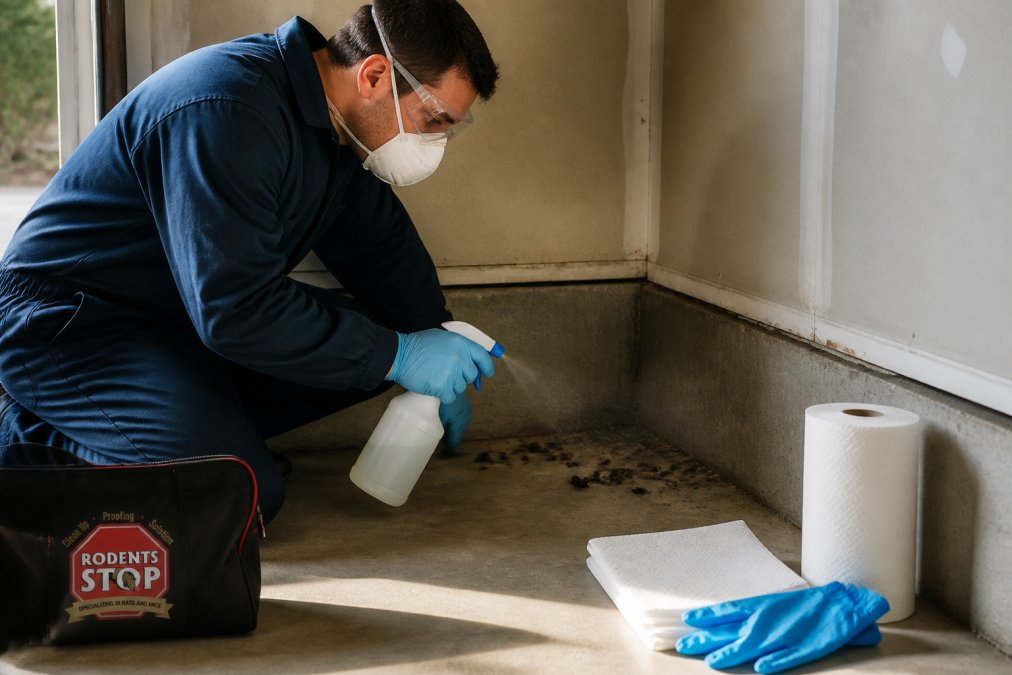
- Spray first, never sweep. Saturate droppings, nesting material, and surrounding surfaces with a disinfectant solution. Let it sit for at least five minutes.
- Pick up with paper towels. Wipe from the outside of the pile inward to avoid scattering material.
- Place waste in a sealed bag. Double-bag it and tie both bags closed before carrying them out.
- Disinfect the area again. Wipe every surface within a few feet of the contamination.
- Dispose of PPE and wash up. Shower and change clothes immediately after finishing.
Never use a standard shop vacuum or household vacuum on dried droppings. The exhaust aerosolizes contaminated particles and disperses them through the room, which is the fastest way to turn a contained mess into a respiratory hazard.
The Best Way to Remove Rat Smell
The best way to remove rat smell is not to cover it up but to break down the odor-causing compounds at the source, treating the pheromones and uric acid crystals rather than masking them with air fresheners or bleach.
Bleach is the most common mistake we see. It kills bacteria on contact but does nothing to uric acid crystals, the actual source of persistent rodent odor. Those crystals react to humidity and release smell for years.
A practical test: if the smell returns on a damp day, you are dealing with uric acid crystals that were never neutralized.
Enzymatic Cleaner for Rodent Urine: How It Works
An enzymatic cleaner for rodent urine uses live bacteria and enzymes to digest the uric acid crystals, proteins, and pheromone compounds that cause odor. The enzymes break the chemical bonds holding these molecules to the surface, converting them into harmless byproducts.
Standard disinfectants kill bacteria but leave the crystals intact. Enzymatic formulas consume them. That difference explains why one treatment holds and the other fades within weeks.
Surface-Specific Neutralization: Porous vs. Non-Porous
Not every surface responds the same way, and this is where most DIY cleanup fails.
| Surface Type | Examples | Treatment Approach | Why It Matters |
|---|---|---|---|
| Non-porous | Tile, glass, metal, sealed concrete | Disinfect, then enzymatic spray, then wipe | Pheromones sit on top and remove easily |
| Semi-porous | Painted drywall, wood framing, unfinished concrete | Saturate and allow extended dwell time | Compounds soak into the top layer |
| Porous | Insulation, carpet, upholstery, cardboard | Remove and replace, do not attempt to clean | Contamination reaches the core and cannot be extracted |
Insulation is the item most homeowners try to save and the one that almost always needs to go. Batting insulation acts like a sponge for urine and pheromones, and no spray reaches the contamination trapped inside the fibers. Removing it is usually faster and cheaper than repeated treatments that never fully work.
Natural vs. Chemical Repellents: What Actually Works
Natural repellents like peppermint oil, citronella, and cedarwood can discourage rodents from lingering, but they do not neutralize pheromones already in the environment. They are a deterrent layer, not a cleanup solution.
Predator scent products work on a similar principle: they introduce an olfactory cue that signals danger. The limitation is the same. If existing rat pheromones remain, new rodents still read the space as safe territory.
Chemical repellents vary widely in effectiveness and some carry real risks to pets and children. Ammonia-based products mimic predator urine, but ammonia is a respiratory irritant and should never be used in enclosed spaces without serious ventilation.
| Approach | Mechanism | Best Use | Limitation |
|---|---|---|---|
| Enzymatic cleaner | Digests uric acid and pheromones | Post-removal surface treatment | No repellent effect |
| Peppermint or cedarwood oil | Irritates rodent senses | Ongoing deterrent in clean spaces | Does not remove existing markers |
| Ammonia products | Mimics predator scent | Outdoor perimeter only | Toxic fumes indoors, pet risk |
| Predator scent | Triggers fear response | Boundary areas | Fades quickly, needs reapplication |
Sealing Entry Points and Post-Cleanup Monitoring
Neutralizing pheromones without sealing entry points is a temporary fix. Rats will find the same gap again, and the scent trail makes your home the obvious destination.
Finding and Sealing Entry Points by Material
Walk the exterior of the structure and inspect these common entry points:
- Gaps around utility lines, pipes, and vents
- Cracks in the foundation larger than a quarter inch
- Damaged vent screens and crawl space covers
- Gaps under garage doors and exterior doors
- Roof line intersections and soffit openings
The seal material matters as much as the seal itself, because rats gnaw through soft materials in a single night. Match material to substrate:
| Substrate | Best Seal Material | Why |
|---|---|---|
| Concrete, brick, masonry | Copper mesh packed into the gap, then hydraulic cement or mortar over it | Rats cannot chew copper; cement locks the mesh in place |
| Wood framing, siding | Hardware cloth (19-gauge or heavier) stapled, then sealed with exterior caulk | Chewing-resistant and flexes with the wood |
| Metal flashing, vents | Galvanized steel mesh plus a metal collar | Prevents push-through and rust-out |
| Gaps under doors | Rubber or metal door sweeps with a rigid backing | Foam weatherstripping alone is chewed through |
Expanding foam alone is the most common mistake. Rats chew straight through cured foam, and it hides the gap from future inspections. Use foam only as a backing behind copper mesh or hardware cloth, never as the sole barrier.
Post-Cleanup Monitoring: Verifying the Pheromone Trail Is Gone
This is the step almost every DIY guide skips, and the only way to know whether your neutralization worked. Traps catching nothing for a week is not proof, it may just mean rats have not found the entry yet.
Two practical verification methods:
UV blacklight inspection. Rat urine fluoresces under a 365 nm UV flashlight. After treatment, walk previously contaminated areas in a dark room with the UV light. Fresh urine glows bright yellow-green; treated residue either does not fluoresce or shows only a faint, dull stain. Any bright new glow means a rat has been back and the pheromone trail is still active.
Tracking powder or flour test. Lightly dust unscented talc or plain flour along suspected travel paths, wall bases, crawl space joists, entry points. Check after 24 to 48 hours with a flashlight. Fresh footprints or tail drag marks confirm active traffic. No marks across several checks, plus no new droppings, is a strong signal the pathway is broken.
Run both checks weekly for the first month after treatment, then monthly for two more months. A common pattern: activity drops sharply in week one, then a single new visitor appears in week three, usually a rat that followed the old outdoor trail to the sealed entry and gave up. If activity continues past week four, the pheromone trail was not fully neutralized or an entry point was missed.
Do not rely on bait stations alone as your monitoring method. A bait station that is being visited tells you rats are present, but an untouched station tells you nothing, rats may simply be avoiding it. Pair bait stations with UV or powder checks so you have a positive signal, not just an absence of one.
The three-part sequence that works: remove the contamination, neutralize the pheromones with an enzymatic treatment, then seal the entry points and verify with UV or tracking powder. Skip any one of the three and the infestation returns.
When to Call a Professional Rodent Cleanup Service
Professional rodent cleanup becomes the practical choice when contamination has reached insulation, sub-floor cavities, or HVAC ductwork, areas where DIY cleaning cannot reach the contamination and where health risk is highest.
Signs you should stop and call someone:
- Droppings or nesting material inside wall cavities or under flooring
- A persistent odor that returns within days of cleaning
- Contaminated insulation in an attic or crawl space
- Multiple rooms affected across more than one floor
- Anyone in the household with asthma or allergies
Rodent cleanup experts handles exactly this scope: removal of droppings and nesting materials, contaminated insulation removal, HEPA vacuuming, deep cleaning and sanitizing, odor and pheromone treatment, and insulation replacement. We inspect the affected areas, build a cleanup plan around the property’s actual condition, then identify entry points so the problem does not come back.
For landlords and property managers overseeing multiple units, the same process scales across residential complexes and commercial spaces. If you have pets, ask about treatment timing and drying windows, since enzymatic products need to fully dry before animals return.
Rat pheromones turn a cleaned space back into a target, and no amount of scrubbing removes what you cannot see. The fix is a sequence: remove the contamination, neutralize the chemical markers, and close the entry points for good. Rodent cleanup experts provides professional rodent damage cleanup, contaminated insulation removal, HEPA vacuuming, odor and pheromone treatment, and insulation replacement for homes and businesses across Los Angeles, Ventura, San Bernardino, Riverside, and Orange Counties. Get started with Rodent cleanup experts and eliminate the scent trail that keeps bringing rats back.
Frequently Asked Questions
What neutralizes the smell of rat urine?
Enzyme-based cleaners neutralize the uric acid crystals in rat urine that cause the smell. Unlike bleach or standard household cleaners, enzymes break down the source of the odor. For porous surfaces like wood or drywall, you may need to apply multiple treatments or remove contaminated materials. If the odor persists after DIY cleaning, professional remediation with HEPA vacuuming and commercial-grade sanitizers is often necessary to fully eliminate the smell.
How long does rat pheromone scent last in a home?
Rat pheromones can linger for months or even years if not properly neutralized. These scent marks are designed to be long-lasting so rats can follow urine trails back to food and nesting sites. Standard cleaning may temporarily mask the odor, but without enzymatic breakdown, the pheromones remain and continue attracting rodents. Deep cleaning of all contaminated surfaces, including sub-floor areas and insulation, is required to remove the scent completely.
Can you use household cleaners to remove rat pheromones?
Household cleaners like bleach, vinegar, or ammonia-based products can kill bacteria and mask odors, but they do not neutralize pheromones. In fact, ammonia can mimic rat urine and may attract more rodents. To truly remove pheromones, use an enzymatic cleaner specifically formulated for pet or rodent waste. For severe infestations or porous materials, professional cleaning is recommended to ensure complete neutralization.
Are professional-grade enzymatic cleaners necessary for rodent odors?
For light infestations on non-porous surfaces, consumer enzymatic cleaners can work. However, professional-grade products are more concentrated and effective on deep contamination in attics, crawl spaces, and wall voids. Professionals also have access to HEPA vacuums and sanitizers that reach areas homeowners cannot. If the odor persists after DIY attempts or if you have a large infestation, hiring a professional rodent cleanup service is the most reliable way to eliminate pheromones and prevent re-infestation.