Quick Summary
The best natural odor neutralizers are absorbents such as baking soda and activated charcoal, which trap odor molecules rather than just covering them. Vinegar works for surface wiping, while essential oils mainly mask smells. For lasting results, remove the odor source first and then use the right absorbent for the room.
- Baking soda suits carpets, fabric, and refrigerators when left in place for several hours.
- Activated charcoal works best in enclosed spaces such as closets, cars, and small rooms.
- Essential oils mainly mask odors and do not remove the source.
- Cats are especially vulnerable to essential oils because their livers process many compounds poorly.
- If an odor returns within hours of an oil spray, the real source still needs to be found.
Table of Contents
- How Natural Odor Neutralizers Actually Work
- Baking Soda and Activated Charcoal: Pros, Cons, and Best Uses
- Vinegar and Essential Oils: What They Do and Don’t Do
- Best Homemade Odor Eliminator Recipes Compared
- Natural Odor Eliminator for Furniture and Clothes
- Does an Odor Eliminator Machine Beat Natural Options?
- Choosing the Right Neutralizer for Your Home’s Odor Source
- Frequently Asked Questions
Best Natural Odor Neutralizers for Homes That Work
Last Updated: November 6, 2026
How Natural Odor Neutralizers Actually Work
Natural odor neutralizers do not all work the same way, and that difference matters when you are dealing with a home that smells. Rodent Cleanup Experts sees the same mistake again and again: a homeowner buys a fragrant spray, the room smells pleasant for a few minutes, and then the original odor returns. Understanding what a product is doing helps you pick one that matches the problem.
There are three basic mechanisms. Absorbents such as baking soda and activated charcoal trap odor molecules in their porous structure. Neutralizers chemically react with odor compounds to change them into less noticeable forms. Masking agents, including most essential oils, simply cover the smell with a stronger scent. Only the first two address the odor itself, and masking alone rarely solves a source problem.
The practical lesson is to match the mechanism to the source.
Baking Soda and Activated Charcoal: Pros, Cons, and Best Uses
Baking soda is inexpensive, widely available, and works well on general household odors. It is most useful in carpets, cat litter areas, refrigerators, and fabric where you can leave it in place for several hours before vacuuming. Its limit is strength: a light sprinkle will not handle a heavy or concentrated source.
Activated charcoal has a much greater surface area per gram, which is why it is often recommended for enclosed spaces such as closets, cars, and small rooms. The downside is cost and the need to replace or recharge it periodically. Charcoal also adsorbs without destroying the source, so it works best after the source itself has been removed.
We recommend baking soda for routine maintenance and charcoal for persistent, confined odors. Neither is a substitute for finding and cleaning the source.
Vinegar and Essential Oils: What They Do and Don’t Do
Distilled white vinegar is acidic, and that acidity lets it react with some alkaline odor compounds on hard surfaces. That is why it shows up on so many natural cleaning lists. In practice, vinegar works best as a surface wipe on countertops, sinks, appliance exteriors, and bathroom fixtures, where the odor-causing residue sits on the surface. Its own sharp smell fades within a short time as it evaporates. What vinegar does not do is reach odor trapped deep in porous materials such as carpet padding, upholstery foam, subfloor, or drywall. A vinegar spray on the surface above a soaked stain will not neutralize what is underneath.
Essential oils such as lemon, lavender, and tea tree oil are popular because they smell pleasant, but their primary role in a home is masking, not elimination. Scented products are generally better understood as masking agents than as removers. Preference for a fragrance is not the same as removal of the odor, and a pleasant scent can cover an odor for a while before the underlying source becomes noticeable again.
Safety is where these two approaches diverge sharply, and it is the part most natural-odor lists skip. Vinegar is generally low-risk for most households when diluted and used on surfaces, but it can dull some stone finishes, damage certain metals with repeated use, and should not be mixed with bleach because the combination can release harmful gas. Essential oils are a different story. They are concentrated plant compounds, not harmless fragrance, and the precautions matter most in households with pets, young children, asthma, or fragrance sensitivity.
- Pets: Cats are especially vulnerable because their livers process many essential oil compounds poorly. Diffused or sprayed oils, and oils on fur that a cat then grooms off, are a common pattern in pet poison calls. Tea tree, eucalyptus, citrus, peppermint, and pine are among the oils most often flagged. Keep diffusers out of rooms a cat can enter, and do not apply oils to bedding or furniture a pet uses.
- Young children: Curious toddlers ingest and touch everything. Store oils out of reach, avoid floor-level diffusers, and skip oil sprays on toys, cribs, and play mats.
- Asthma and fragrance sensitivity: Even natural volatile compounds can trigger coughing, headaches, or wheezing in sensitive people. A fragrance-free approach, built on absorbents and source removal, is the safer default in a household with asthma or known sensitivity.
- Ventilation: Any spray, natural or not, adds compounds to indoor air. Crack a window or run a fan while you apply it, and give the room time to clear before people and pets return.
A practical rule: use vinegar for surface cleaning and light surface odor, use essential oils only as a short-term finishing scent in a well-ventilated room with no sensitive occupants, and rely on absorbents or source removal when the odor keeps coming back. If a scent returns within hours of an oil spray, the oil was masking, and the next step is finding the source rather than spraying again.
Best Homemade Odor Eliminator Recipes Compared
Many homemade recipes combine baking soda, vinegar, and essential oils in a spray bottle. The table below compares common approaches using the research and general product behavior described above. It is a summary, not a performance test.
| Approach | Main Mechanism | Best For | Main Limitation |
|---|---|---|---|
| Baking soda sprinkle | Absorbs | Carpets, fabric, fridges | Weak on heavy sources |
| Activated charcoal bowls | Absorbs | Closets, cars, small rooms | Needs replacing or recharging |
| Vinegar spray | Neutralizes on surfaces | Hard surfaces, kitchens | Own smell; limited depth |
| Essential oil spray | Masks | Quick, pleasant scent | Does not remove the source |
| Baking soda plus vinegar mix | Partial neutralizing | Surface cleaning | Components can cancel each other out |
When you make a homemade spray, apply it to a small hidden area first, especially on fabric, painted walls, and finished wood.
Natural Odor Eliminator for Furniture and Clothes
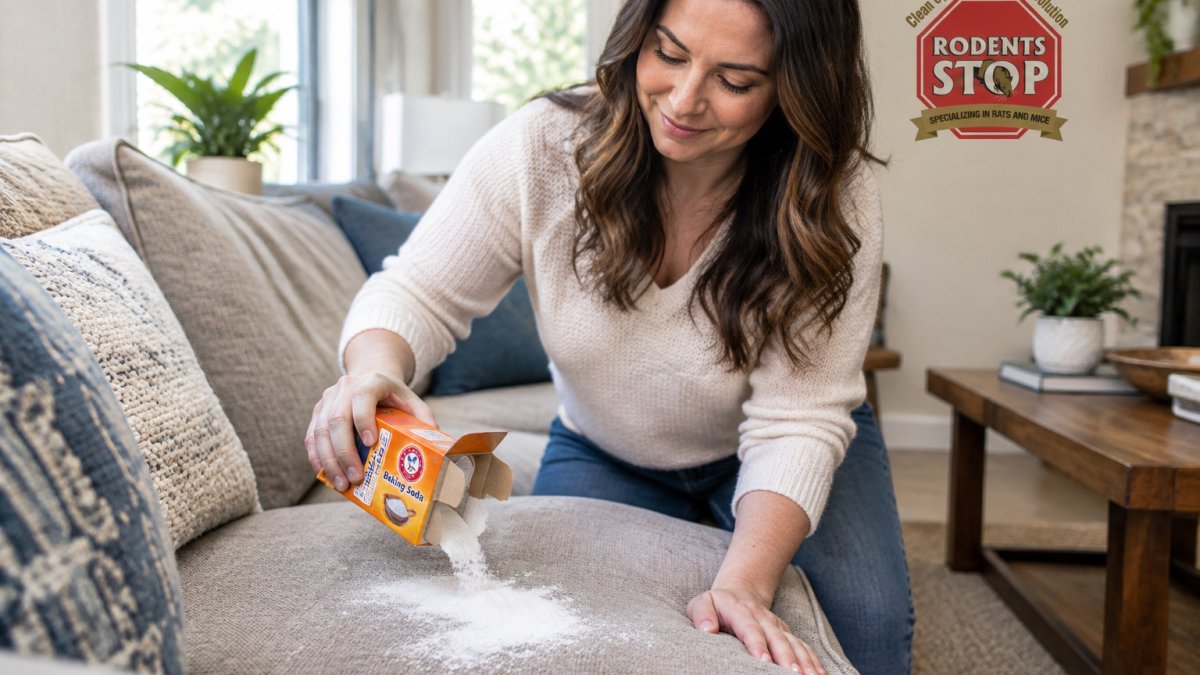
Furniture and clothing hold odor in fibers and foam, so surface sprays rarely reach the problem. A common approach is to sprinkle baking soda over an upholstered cushion or rug, leave it for several hours or overnight, and vacuum thoroughly. For clothes, adding a half cup of baking soda to the wash or soaking garments in a diluted vinegar solution can help, though you should check care labels first.
Activated charcoal sachets placed in a closed drawer or closet can reduce lingering smells over time. Air the item outdoors when possible, since moving air carries odor away from the material.
If the smell comes from urine, smoke, or a rodent source, surface treatment is usually not enough. Contaminated insulation, padding, and subfloor materials may need professional removal, and the risks of droppings and urine are serious enough that you should not handle them without proper protection. Our rodent infestation cleanup service covers situations where contaminated materials need to be removed.
Does an Odor Eliminator Machine Beat Natural Options?
Odor eliminator machines, such as ozone or hydroxyl generators, are sold as more powerful alternatives to natural products. Their results depend heavily on the room, the source, and how they are used.
For a typical household odor, natural options are often enough. For a heavy or building-wide problem, machines may help as part of a larger plan, but they do not replace removing the source.
Choosing the Right Neutralizer for Your Home’s Odor Source
Start by identifying the source, then match the method to the source, the room, and the conditions. A stale kitchen smell, a pet accident, cigarette smoke, and rodent contamination each need a different response, and the same neutralizer can perform very differently in a small closed closet versus a large open living room.
Use this decision path as a starting point:
- Light, general odor: Baking soda or an activated charcoal bowl, with regular ventilation.
- Fabric or upholstery odor: Baking soda left overnight, followed by thorough vacuuming.
- Enclosed space odor: Activated charcoal, with the source cleaned first.
- Rodent or heavy biological odor: Remove the source and contaminated material before using any neutralizer.
That list is the easy part. The harder part is matching the method to the conditions in the room, because the same product can work well in one space and barely register in another.
Room size and airflow. Absorbents work by contact, so they need exposed surface area and air movement to pull odor molecules in. A bowl of activated charcoal in a closed 50-square-foot closet has far more effect per square foot than the same bowl in an open living room with a ceiling fan running.
Humidity and moisture. High humidity works against most absorbents. Baking soda clumps and loses effectiveness when it pulls in moisture, and charcoal can become saturated faster in a damp basement or bathroom. In humid spaces, fix the moisture source first, then use absorbents, and replace or recharge them more often.
Speed versus lifespan. Masking sprays act in seconds and fade in minutes to hours. Vinegar acts on surfaces within minutes but does not penetrate. Baking soda needs hours to overnight in fabric. Activated charcoal works slowly over days to weeks and holds its effect longer in a closed space.
Odor source by type. Cooking odors respond well to ventilation and a surface wipe with vinegar, because the residue is largely on surfaces and in the air. Trash odors usually mean the bin itself needs washing, not just deodorizing. Smoke odor penetrates soft materials and often needs laundering and repeated surface cleaning rather than a single spray.
Prevention and source removal. Before adding any absorber or fragrance, ask whether cleaning, drying, laundering, or improving ventilation would solve it outright. A running bathroom fan, a dryer vent that actually exhausts outdoors, a clean trash bin, and prompt laundering of pet bedding prevent more odor than any product removes.
Realistic expectations and warning signs. Absorbents and neutralizers reduce odor; they do not sterilize a space or remove contamination. If a smell returns within a day or two of treatment, the source is still present.
Rodents in particular leave urine, droppings, and nesting material that can soak into insulation and framing. Our guide on identifying rat urine stains and their health risks explains the warning signs to look for. Our article on why DIY rodent cleaning fails and what works covers why contamination and entry points are easy to overlook. Some homeowners also compare the cost of professional help with the cost of repeated DIY attempts; our piece on whether professional rodent decontamination is worth it walks through that trade-off.
For professional options, see our overview of expert rodent odor removal services.
Frequently Asked Questions
What absorbs odors in a house naturally?
Baking soda and activated charcoal are the two most commonly recommended natural absorbers. Baking soda works well on fabrics, carpets, and open boxes in refrigerators, while activated charcoal can be placed in closets, trash areas, and enclosed spaces. Both work by trapping odor molecules rather than masking them, but neither is a substitute for removing the source of the smell. Replace baking soda every few months and recharge charcoal according to the manufacturer’s instructions for the best results.
What is the best natural deodorizer to use in my house?
The best choice depends on the odor source and the room. Baking soda suits fridges, carpets, and trash bins, white vinegar helps with some cooking and cleaning smells on hard surfaces, and activated charcoal works in closed spaces. Essential oils mainly mask odors and do not remove them. For persistent smells from pets or rodents, cleaning the source comes before any natural deodorizer.
How can I remove odors without masking them?
Masking covers a smell with a stronger scent, while neutralizing or absorbing removes the odor molecules themselves. Start by finding and cleaning the source, then ventilate the room and use an absorber such as baking soda or activated charcoal. Washing fabrics, cleaning surfaces, and improving airflow usually do more than any air freshener alone.
Natural odor neutralizers work best when they are matched to the source and used alongside proper cleaning. Rodent Cleanup Experts provides professional rodent cleanup, sanitation, and odor removal across Southern California, and our team can inspect your property and recommend the right approach. Contact us for a quote, and we will explain what the work involves before anything begins.
