Table of Contents
- What Attic Restoration After Rodent Infestation Actually Involves
- Rodent Dropping Cleanup Safety Protocols: DIY vs. Professional
- The Attic Restoration Process: Step-by-Step Decontamination
- Attic Insulation Replacement After Rodents: What You Need to Know
- Best Way to Remove Rat Smell From Your Attic
- Does Homeowners Insurance Cover Attic Remediation Costs?
- Long-Term Maintenance Checklist to Prevent Re-Infestation
- Conclusion
What Attic Restoration After Rodent Infestation Actually Involves
Attic restoration after rodent infestation is the process of removing contaminated materials, decontaminating surfaces, sealing entry points, and replacing damaged insulation to return an attic to a safe, habitable condition. Rodent Cleanup Experts has worked through many of these jobs across Southern California, and the pattern is consistent: what homeowners see on the surface is rarely the full picture. Rats and mice leave behind far more than droppings, urine saturates insulation, nesting materials harbor bacteria, and gnawed wiring creates fire hazards. Attic remediation addresses all of it systematically.
Signs Your Attic Has a Rodent Problem
A rodent infestation rarely announces itself loudly. By the time most homeowners investigate, the damage has been building for weeks or months. Watch for scratching or scurrying sounds in the ceiling at night, a persistent musty or ammonia-like odor from vents, visible droppings along joists, compressed or shredded insulation, gnaw marks on wood or wiring, and grease trails along walls. Any one of these warrants a thorough attic inspection; multiple signs together mean the infestation has been active long enough to cause real structural and biohazard concerns.
Health Risks: Why Rodent Droppings and Urine Are Serious Biohazards
Rodent feces and urine carry pathogens that pose genuine respiratory risks. According to the CDC’s hantavirus guidance for the public, hantavirus pulmonary syndrome can be contracted by breathing in dust contaminated with rodent droppings or urine. The virus becomes airborne when dried feces are disturbed, which is exactly what happens when someone vacuums an attic without proper precautions. Beyond hantavirus, rodent waste has been associated with leptospirosis, salmonellosis, and rat-bite fever. HVAC duct contamination is a particular concern: if your ductwork runs through the attic and rodents have nested near or inside it, those pathogens can circulate throughout the entire home every time the system runs.
Rodent Dropping Cleanup Safety Protocols: DIY vs. Professional
Most guides skip the honest conversation here. The truth is that DIY cleanup is appropriate for minor, contained incidents, and genuinely dangerous for anything larger.
What the CDC Recommends Before You Touch Anything
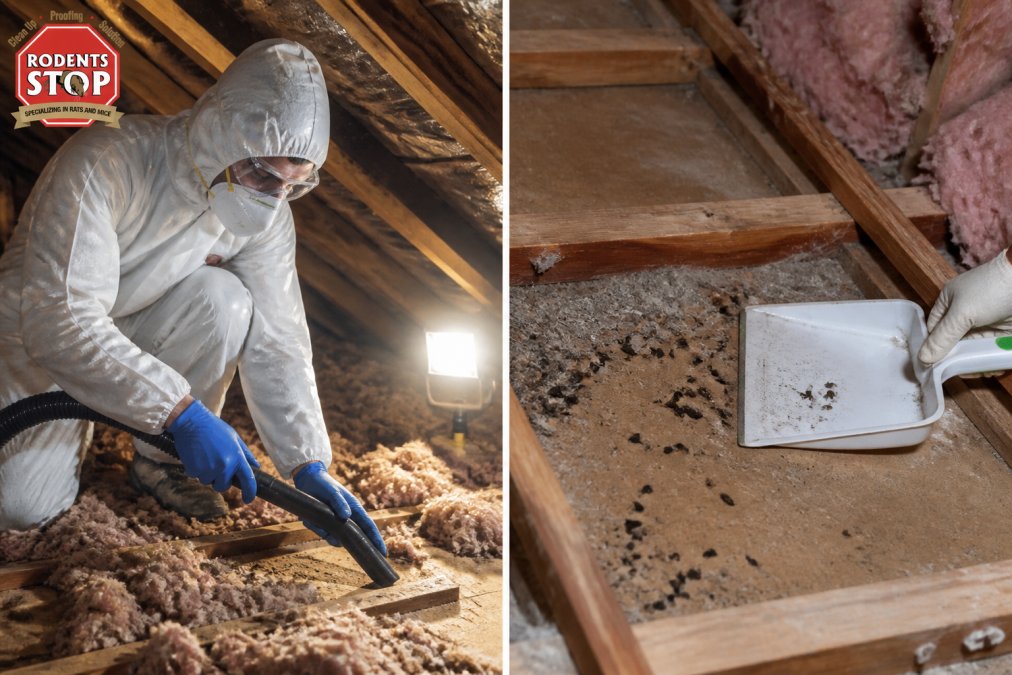
The CDC’s rodent cleanup guidelines are specific and worth following exactly. Before any cleanup begins: ventilate the space for at least 30 minutes by opening windows and doors, put on rubber or plastic gloves, wear an N95 respirator or better, wet down droppings and nesting materials with a disinfectant or bleach solution before picking them up (never dry-sweep or vacuum without HEPA filtration), double-bag all contaminated waste, disinfect all surfaces the rodents may have contacted, and wash hands thoroughly after removing gloves. The CDC explicitly warns against vacuuming rodent droppings with a standard vacuum cleaner, as doing so aerosolizes the pathogens and dramatically increases inhalation risk (the CDC).
When DIY Cleanup Crosses Into Professional Territory
A common mistake is underestimating scope. If you open the attic hatch and see droppings scattered across a large area, nesting materials in multiple locations, or insulation that is visibly soiled or compressed, that is a professional-grade biohazard cleanup situation. Professional remediation is the right call when the infestation covered a significant portion of the attic floor, insulation is contaminated and requires removal, there is evidence of HVAC duct contamination, anyone in the household has respiratory conditions or is immunocompromised, or you lack the proper PPE or a HEPA-rated vacuum. Rodent infestation cleanup services handle the full scope of decontamination, including HEPA vacuuming, EPA-registered sanitization, and pheromone treatment, ensuring the job is completed safely and thoroughly.
Never use a regular vacuum [cleaner to](/best-way-to-clean-rat-urine/) clean up rodent droppings. Standard vacuums exhaust air, and the pathogens in it, directly into the room. Only HEPA-filtered vacuums designed for biohazard work are appropriate.
The Attic Restoration Process: Step-by-Step Decontamination
Professional attic restoration follows a structured sequence. Skipping steps or reordering them produces incomplete results.
Inspection and Entry Point Identification
The first step is a detailed attic inspection that documents the full extent of contamination and locates every rodent entry point. Common entry points include gaps around pipe penetrations, deteriorated or missing soffit vents, openings where the roofline meets the fascia board, gaps around HVAC lines, and cracks in the foundation where it meets wood framing. Pest exclusion, the physical sealing of these gaps with rodent-proof materials, is a core part of attic restoration, not an optional add-on.
Removing Nesting Materials, Feces, and Contaminated Debris
Once the scope is documented and PPE is on, removal begins. Nesting materials, feces, and any contaminated debris are wet-treated with a disinfectant solution first, then carefully removed and double-bagged for disposal. HEPA vacuuming follows to capture fine particulate matter that cannot be picked up manually. If contaminated insulation is present, it is removed at this stage. Attempting to sanitize insulation in place is rarely effective.
Sanitization, Virucide Application, and Air Quality Treatment
After physical removal, all attic surfaces are treated with an EPA-registered virucide and disinfectant. Odor neutralization follows decontamination. Pheromone treatment is important here: rodent pheromones left in the space can attract new rodents even after the original infestation is eliminated. Air quality treatment may include fogging with an appropriate antimicrobial agent, and attic ventilation is checked and restored to ensure proper airflow after new insulation is installed.
Ask any remediation provider whether their sanitization step uses an EPA-registered virucide specifically rated for hantavirus. Some general-purpose disinfectants are not rated for this application.
Attic Insulation Replacement After Rodents: What You Need to Know
Attic insulation replacement after rodents is one of the most consequential decisions in the restoration process. Get it right and you restore both safety and thermal efficiency.
When Insulation Must Be Replaced vs. When It Can Be Salvaged
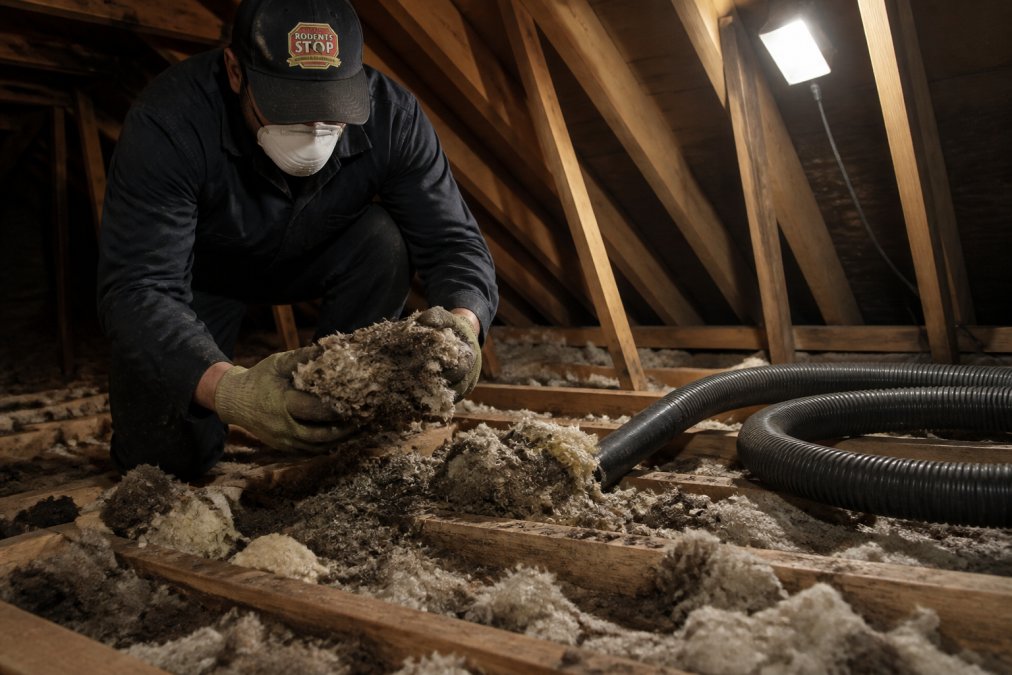
Insulation must be replaced when it has been visibly soiled with rodent droppings or urine, shows compression or matting from nesting activity, has persistent odor after surface sanitization, or has been wet from rodent urine to the point of losing its R-value. In practice, when an infestation has been active long enough to cause visible damage, replacement is almost always the right call for both safety and long-term thermal performance.
Insulation Material Comparison for Replacement
Choosing replacement insulation involves trade-offs between performance, cost, and installation method.
| Insulation Type | R-Value per Inch | Best For | Key Consideration |
|---|---|---|---|
| Blown-in fiberglass | ~2.2-2.7 | Most attic floors | Fast install, widely available |
| Blown-in cellulose | ~3.2-3.8 | Dense-pack applications | Recycled content, good air sealing |
| Spray foam (closed-cell) | ~6.0-7.0 | Air sealing + insulation combo | Higher cost, excellent vapor barrier |
| Batts (fiberglass) | ~3.1-3.4 | Accessible attic spaces | DIY-friendly, but gaps reduce performance |
Blown-in fiberglass and cellulose are the most common choices for attic floor replacement after rodent damage. Closed-cell spray foam is worth considering when air sealing is a priority alongside insulation.
The insulation type you choose affects more than just warmth. Closed-cell spray foam doubles as an air seal and vapor barrier, which can prevent future moisture intrusion that would otherwise attract pests back to the space.
Best Way to Remove Rat Smell From Your Attic
The best way to remove rat smell from an attic is to eliminate the source first, then treat the residual odor with enzyme-based neutralizers and an EPA-registered disinfectant. Rat smell has two components: biological material (urine-saturated insulation, nesting materials, and deceased rodents) and pheromone residue that persists long after physical waste is removed.
Odor removal follows this sequence: remove all contaminated insulation and nesting materials, HEPA vacuum all surfaces, apply an enzyme-based cleaner to wood surfaces, follow with an EPA-registered disinfectant, allow full drying time before new insulation is installed, and apply a pheromone-neutralizing treatment. Persistent smell after a DIY cleanup is almost always because one of these steps was skipped or the contaminated insulation was left in place.
Does Homeowners Insurance Cover Attic Remediation Costs?
Homeowners insurance coverage for attic restoration after rodent infestation is inconsistent and frequently misunderstood. Most standard homeowners policies classify rodent damage as a maintenance issue rather than a sudden, accidental loss, which means the remediation cost is typically not covered. However, if rodents caused a sudden, accidental event that IS covered (such as gnawing through wiring that caused a fire or water damage), the resulting damage from that event may be covered. Some policies include limited coverage for sudden animal damage, and umbrella policies may offer broader coverage. Before assuming you are not covered, review your specific policy language and call your insurer directly. Document everything before cleanup begins with photographs of the contamination, nesting materials, and any structural damage.
Long-Term Maintenance Checklist to Prevent Re-Infestation
Attic restoration is only permanent if the conditions that allowed the infestation are corrected. Rodents do not find their way into attics by accident. Use this checklist on a twice-yearly basis, ideally in early spring and late fall:
Exterior Inspection
- Inspect all soffit vents for damage or missing screens
- Check where utility lines, pipes, and conduit enter the structure; seal gaps larger than a quarter-inch with steel wool and caulk or metal flashing
- Examine the roofline and fascia for gaps, rot, or missing sections
- Trim tree branches that overhang or touch the roofline
- Check the foundation perimeter for cracks or gaps where it meets wood framing
Attic Interior
- Inspect insulation for signs of compression, discoloration, or nesting activity
- Check HVAC ductwork for gnaw marks or separation at joints
- Look for fresh droppings along joists or near the eaves
- Verify that any previously sealed entry points remain intact
- Check attic ventilation to ensure airflow is unobstructed
Ongoing Practices
- Store food (including pet food) in sealed hard-sided containers
- Keep garage doors closed when not in use
- Remove dense ground cover or wood piles stored against the structure
- Address moisture issues promptly
A common mistake is completing a full attic restoration and then neglecting the exterior inspection that prevents re-entry. The cleanup is the recovery. The maintenance checklist is the prevention.
Dealing with rodent damage in your attic is stressful, and the stakes are real: contaminated insulation, compromised air quality, and the risk of rodents returning if entry points are not properly sealed. Rodent Cleanup Experts provides comprehensive attic restoration services across Los Angeles, Ventura, San Bernardino, Riverside, and Orange Counties, including contaminated insulation removal, HEPA vacuuming, EPA-registered sanitization, pheromone treatment, and professional insulation replacement. Contact Rodent Cleanup Experts to schedule an inspection and get a cleanup plan tailored to your property.
Frequently Asked Questions
How do I safely clean my attic after a rodent infestation?
Safe attic cleanup starts with proper PPE: an N95 or P100 respirator, disposable gloves, and eye protection. The CDC advises against dry sweeping or vacuuming rodent droppings, which can aerosolize hantavirus particles. Instead, saturate droppings and nesting materials with a disinfectant spray, let it soak for five minutes, then bag everything in sealed plastic. For heavily contaminated attics, professional attic remediation is the safer option, especially when contaminated insulation must be removed.
When is it necessary to replace attic insulation after a rodent infestation?
Attic insulation replacement after rodents is necessary when the material is visibly saturated with feces and urine, compressed by nesting activity, or has absorbed persistent odors that disinfection cannot eliminate. Blown-in cellulose and fiberglass batts both absorb rodent urine deeply, making surface cleaning ineffective. If the insulation has lost its thermal efficiency or shows widespread contamination, full removal and replacement restores both air quality and energy performance. A professional inspection helps determine the extent of damage before any work begins.
What are the health risks of leaving rodent droppings in an attic?
Rodent droppings and urine carry pathogens including hantavirus, leptospirosis, and salmonella. Hantavirus is particularly dangerous: the CDC confirms it spreads when dried feces are disturbed and particles become airborne. Even without direct contact, contaminated attic air can circulate through HVAC duct systems into living spaces, creating ongoing respiratory risks. Prolonged exposure is linked to allergic reactions and worsening asthma. Prompt attic decontamination significantly reduces these risks for everyone in the home.
How do professionals neutralize persistent rodent pheromone odors?
The best way to remove rat smell goes beyond surface cleaning. Professionals apply enzyme-based or virucide-grade disinfectants that break down the proteins in rodent urine and pheromones at a molecular level. After sanitization, odor neutralizers, not masking agents, are applied to affected wood, drywall, and structural surfaces. In severe cases, ozone treatment or fogging may be used. Standard household bleach dilutions can reduce surface bacteria but do not fully neutralize pheromone compounds, which is why DIY odor removal often fails.
Does homeowners insurance cover attic restoration after rodent damage?
Most standard homeowners insurance policies exclude rodent damage because insurers classify it as a maintenance issue rather than a sudden, accidental loss. However, if rodents chew through wiring and cause a fire, or if their activity leads to a covered peril, that secondary damage may be reimbursable. Review your policy's exclusion language carefully and document all damage with photos before any cleanup begins. Some insurers will cover attic remediation costs when the infestation is tied to a covered structural event, so it is worth filing a claim inquiry.
Can rodent urine damage attic wiring and HVAC systems?
Yes. Rodent urine is corrosive and can degrade electrical insulation on wiring over time, increasing fire risk. Rats and mice also gnaw through wiring insulation directly, which is a leading cause of attic fires. HVAC duct contamination is another serious concern: rodents nest inside ductwork and leave droppings that circulate through the air system. A thorough attic restoration includes inspecting both electrical components and HVAC ducts for damage, not just cleaning the insulation and floor surfaces.
This article was written using GrandRanker