Table of Contents
- Why Rodent Droppings Are a Health Hazard, Not Just a Mess
- Why DIY Rodent Cleanup Often Makes Things Worse
- Rodent Droppings Cleanup Safety Protocols Professionals Follow
- How to Sanitize Insulation After Rats: Removal, Disinfection, and Replacement
- The Cost of Professional Attic Cleanup vs. DIY: What You’re Really Paying For
- Long-Term Structural Impact and Post-Cleanup Verification
- Conclusion: Making the Call on Professional Rodent Cleanup
- Frequently Asked Questions
Last Updated: September 12, 2026
Why Rodent Droppings Are a Health Hazard, Not Just a Mess
Rodent cleanup is necessary because rodent waste carries pathogens that survive in dust and insulation long after the animal is gone. This guide from Rodent cleanup experts explains what you are actually dealing with, why sweeping and vacuuming can make it worse, and how professionals handle the job safely.
Most homeowners treat a rodent problem as a pest problem. Trap the animal, sweep up the mess, move on. That approach misses the part that actually threatens your health: the contamination left behind in your attic, crawl space, and walls.
Hantavirus, Salmonella, and Leptospirosis: What You’re Breathing In
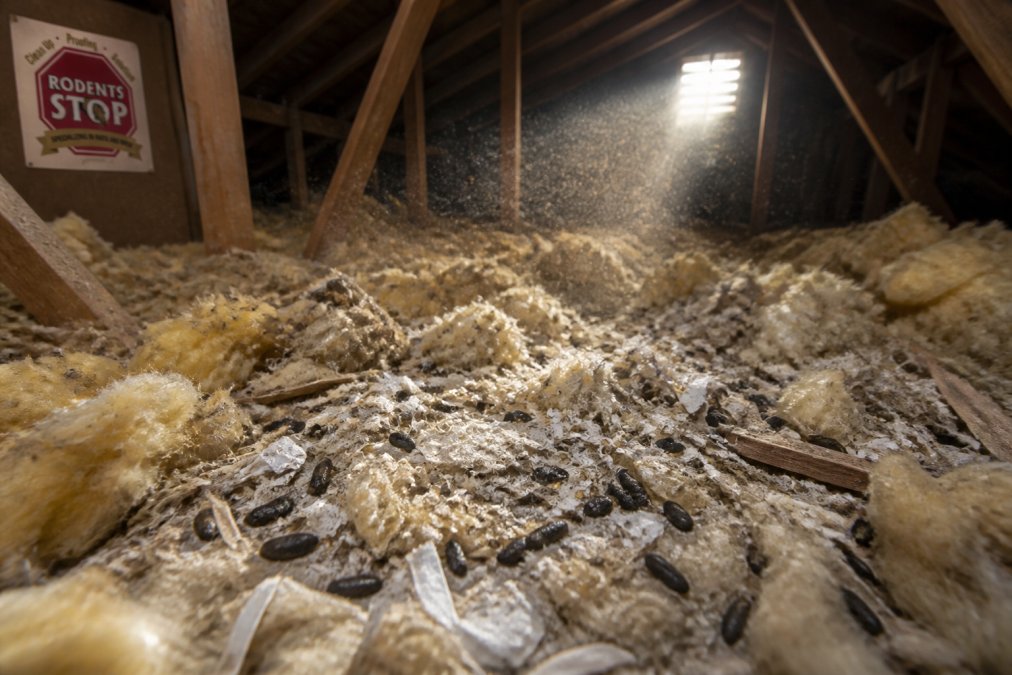
Rodent droppings, urine, and saliva can carry hantavirus, salmonella, and leptospirosis. Each one reaches people through a different route, and each one behaves differently once it dries out.
Hantavirus is the one that worries public health officials most. It spreads when dried fecal matter and urine are disturbed and become airborne, and people inhale the particles. The CDC guidance on hantavirus notes that rodent infestations in enclosed spaces like attics and crawl spaces create the highest exposure risk because ventilation is poor and dust accumulates.
Salmonella moves through contaminated surfaces and food. Leptospirosis spreads through urine contact with broken skin, eyes, or mucous membranes. In an attic, all three can be present at once, layered into insulation, nesting materials, and the dust coating every joist.
How Airborne Particles Spread Through Your Home
Air quality inside a contaminated home drops in ways you cannot see. Rodent urine crystallizes as it dries, and fecal matter breaks down into fine particles that settle into insulation fibers and ductwork.
Once those particles are airborne, your HVAC system becomes a distribution network. Every time the system runs, it can pull contaminated dust from an attic or crawl space and push it through living areas. That is one reason respiratory issues, allergy symptoms, and unexplained coughing show up in rooms far from where the rodents actually lived.
Why DIY Rodent Cleanup Often Makes Things Worse
DIY rodent cleanup often makes contamination worse because the tools homeowners reach for first, a standard vacuum and a bleach spray, are the exact tools that spread pathogens. The instinct is understandable. The result usually is not.
The Vacuum and Bleach Mistake Most Homeowners Make
A common mistake is running a shop vac or household vacuum over droppings. Standard vacuums do not contain airborne particles; they exhaust them. The filter catches some debris, but fine dust carrying pathogens blows straight back into the room, and you are standing in the middle of it.
Bleach has its own problem. Spraying bleach solution directly onto dry droppings wets the surface and kicks up dust before the disinfectant can work. The CDC recommends against dry sweeping or vacuuming rodent waste precisely because it aerosolizes contamination. Bleach also degrades quickly and can damage insulation and wiring if it soaks in.
Never dry sweep or vacuum rodent droppings. The particles you cannot see are the ones that reach your lungs, and a standard vacuum filter does not stop them.
Rodent Droppings Cleanup Safety Protocols Professionals Follow
Rodent droppings cleanup safety protocols exist because contamination does not stay where it lands. Professionals treat every attic and crawl space as a biohazard zone until testing says otherwise, and the protocol starts before anyone touches a single dropping.
PPE, Respirators, and N95 Masks: What’s Required
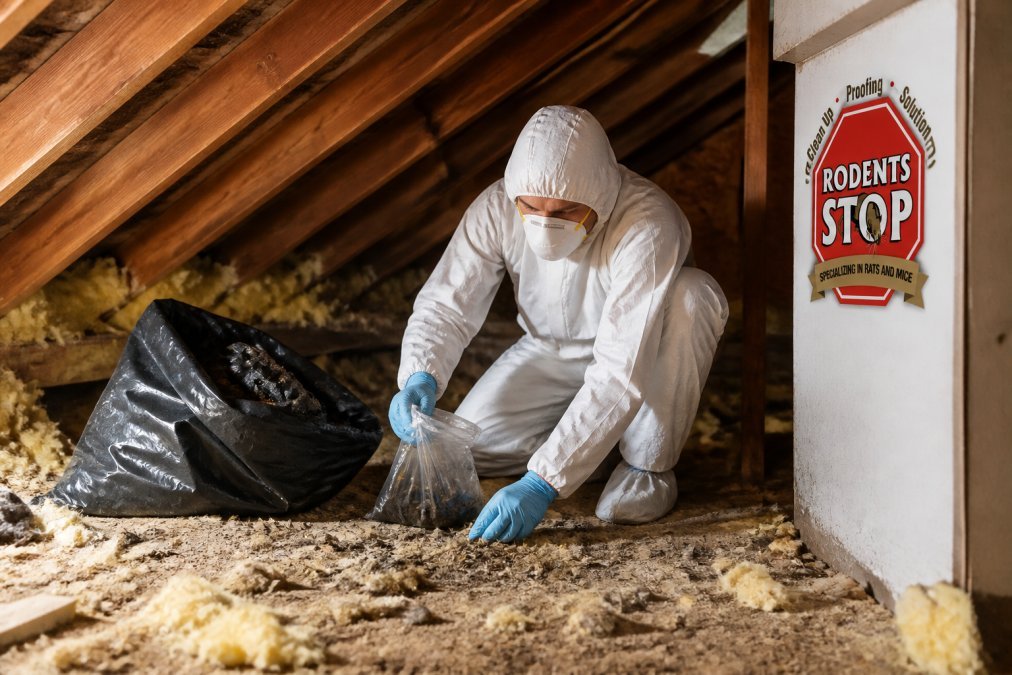
Personal protective equipment is the first line of defense. At minimum, that means:
- N95 mask or a fitted respirator rated for airborne particles
- Disposable coveralls that seal at the wrists and ankles
- Nitrile gloves taped over the cuffs
- Eye protection or a full-face shield
- Boots that can be disinfected or discarded
The OSHA respiratory protection standards require a fitted respirator when workers handle known biohazards in enclosed spaces. An N95 mask handles most residential jobs; heavier contamination or confined spaces call for a powered air-purifying respirator.
Ventilation matters too. Crews open windows and use negative air machines to pull contaminated air out rather than letting it circulate through the house.
How to Sanitize Insulation After Rats: Removal, Disinfection, and Replacement
How to sanitize insulation after rats depends on how deep the contamination goes. Insulation is porous, and once rodent urine and fecal matter soak into fiberglass or cellulose, surface cleaning does not fix it. The material has to come out.
The process follows a set sequence:
- Seal the work area with plastic sheeting to contain dust.
- Remove contaminated insulation, nesting materials, and droppings into sealed bags.
- HEPA vacuum all exposed surfaces, including joists and wiring.
- Apply a disinfectant solution rated for the pathogens present.
- Treat for odor and pheromones, which is what brings rodents back.
- Install new insulation once the cavity is verified clean.
Removing insulation is the step homeowners skip, and it is the step that determines whether the problem is actually solved. Disinfection and deodorization only work on a clean surface.
Pheromone treatment is the step most people miss. Rodents follow scent trails left by previous occupants, so sanitizing without neutralizing those trails invites a repeat infestation.
The Cost of Professional Attic Cleanup vs. DIY: What You’re Really Paying For
The cost of professional attic cleanup is not just a labor charge. It covers containment equipment, HEPA filtration, disinfectants, disposal of hazardous waste, and replacement insulation. Pricing depends on the size of the affected area, the depth of contamination, and whether insulation must be replaced, so the honest answer is that it varies by property.
DIY looks cheaper on paper. The comparison rarely holds up once you price out what a failed attempt actually costs.
| Factor | DIY Cleanup | Professional Cleanup |
|---|---|---|
| Equipment | Household vacuum, bleach | HEPA vacuums, negative air machines |
| Health risk | High (airborne pathogens) | Contained and controlled |
| Insulation | Usually left in place | Removed and replaced |
| Odor treatment | Surface sprays | Pheromone and odor neutralization |
| Repeat infestation | Common | Reduced with entry-point sealing |
The Cost of Failure: Why the Cheaper Option Often Isn’t
Most homeowners compare the price of a DIY weekend against a service quote. That comparison leaves out the two costs that actually decide which option is cheaper: medical exposure and repeat remediation.
A single urgent-care or emergency-room visit for a respiratory complaint runs into the hundreds to low thousands before insurance, and hantavirus treatment in particular can escalate into intensive care. That is the exposure cost of a cleanup done without containment. It does not show up on any DIY shopping list, but it is the most expensive line item in the whole job.
Repeat remediation is the second hidden cost. When pheromone trails are not neutralized and entry points are not sealed, rodents return, and the second cleanup is more expensive than the first because the new contamination sits on top of whatever the first pass missed. A common pattern is a homeowner who spends a modest amount on DIY supplies, sees the problem return within a season, and then pays for a full professional job anyway, having added a wasted round of labor and disposal on top.
What Actually Drives the Professional Quote
When a professional assesses a property, the quote reflects four variables:
- Square footage of contaminated area. Attic and crawl space volume, not house size, sets the scope.
- Depth of contamination. Fresh droppings and nesting material cost less to remove than urine-soaked insulation that must be bagged as hazardous waste.
- Insulation replacement. Removal and replacement of fiberglass or cellulose is the single largest line item in most jobs.
- Access and containment difficulty. Low-clearance crawl spaces and finished attics require more labor and more containment material.
Because those variables swing widely, a responsible provider inspects before quoting. Anyone who gives a firm number over the phone without seeing the space is guessing.
Ask for a written scope of work, not just a number. A quote that lists containment, HEPA vacuuming, disinfection, pheromone treatment, and insulation replacement separately tells you exactly what you are paying for and what a cheaper bid is leaving out.
The Landlord Math
For rental property owners, the cost-of-failure calculation tilts even further toward professional cleanup. A repeat infestation means tenant complaints, possible turnover, and repair bills that dwarf the original cleanup quote. One avoided vacancy typically covers the difference between a DIY attempt and a properly scoped professional job.
Hidden Costs of DIY: Health, Structural Damage, and Repeat Infestations
The hidden costs show up later. Respiratory issues from repeated exposure to airborne particles. Wiring and HVAC components chewed behind walls, where you cannot see the damage until something fails. And the infestation itself, which returns because the pheromone trails were never neutralized.
A second round of cleanup costs more than the first, because the contamination is now layered on top of whatever the first attempt missed. For landlords managing rental properties, that repeat cycle also means tenant complaints, turnover, and repair bills that dwarf the original cleanup quote.
Long-Term Structural Impact and Post-Cleanup Verification
Rodents do not just contaminate. They damage, and the damage continues after the animals are gone. Chewed wiring, compromised insulation performance, and gnawed structural members are common findings, and the EPA guidance on indoor air quality points out that contaminated insulation and compromised ventilation directly affect indoor air quality long after the animals are removed.
Why Urine-Soaked Materials Fail Over Time
The mechanism matters more than the warning. Rodent urine is acidic and hygroscopic, meaning it pulls moisture from the air. When urine soaks into fiberglass or cellulose insulation, it does two things at once: it compresses the material and destroys the air pockets that give insulation its R-value, and it keeps the surrounding cavity damp. Damp insulation loses thermal performance, and persistent moisture creates conditions for mold growth on the wood framing behind it.
That is the secondary damage most homeowners never see. The insulation looks intact from the surface while the joists behind it are staining, softening, and losing structural strength. By the time a sagging ceiling or a soft spot in the floor shows up, the damage has been developing for months.
Wiring is the other silent failure. Rodent teeth grow continuously, so gnawing is not hunger-driven, it is maintenance. Insulation on electrical cable is a convenient material to wear teeth down on. Exposed conductors behind drywall are a fire risk that no visual inspection from the living space will catch.
How Professionals Verify a Space Is Actually Clean
This is where most DIY jobs end too early, and where the value of a professional service becomes measurable. Verification is not a visual once-over. It is a set of checks that confirm the contamination is gone, not just hidden.
- Surface ATP testing. An ATP meter swabs a surface and returns a reading of biological residue in seconds. A clean reading confirms that organic contamination has been physically removed, not just disinfected over.
- Moisture readings. A pin or pinless moisture meter checks framing and subfloor for residual dampness that would feed mold. Readings are compared against a dry baseline for the same structure.
- Air quality checks. Particle counters and, in heavier jobs, air sampling confirm that airborne contamination has been captured rather than redistributed by the HVAC system.
- Odor and pheromone verification. A trained nose and, where needed, a UV inspection confirm that scent trails are neutralized. If pheromones remain, rodents will return regardless of how clean the surfaces are.
- Entry-point audit. Every gap larger than a quarter inch is identified and sealed. Verification is meaningless if the access remains open.
What a Verified Clean Actually Means
A verified clean means three things are true at once: surfaces test free of biological residue, the structure is dry enough to resist mold, and the building envelope is sealed against re-entry. Without all three, you have a room that looks clean and a problem that is still active.
Cleanup without entry-point sealing is a temporary fix. The contamination comes back because the access does not go away. Verification is what separates a cleanup that holds from one that has to be repeated.
Conclusion: Making the Call on Professional Rodent Cleanup
The decision comes down to what you are actually removing. Droppings and nesting materials are the visible part. The pathogens in the dust, the soaked insulation, and the pheromone trails are the part that determines whether the problem stays solved.
Rodent cleanup experts handles the full scope: removal of droppings and nesting materials, contaminated insulation removal, HEPA vacuuming, deep cleaning and sanitizing, odor and pheromone treatment, and professional replacement of damaged insulation. We inspect the affected areas first, build a cleanup plan around the condition of your property, and identify potential entry points so rodents have a harder time returning.
Get started with Rodent cleanup experts and restore your attic, crawl space, or garage to a clean, safe, and sanitary condition.
Frequently Asked Questions
What are the health risks of cleaning up rodent droppings?
Rodent droppings can carry hantavirus, salmonella, and leptospirosis. When you sweep or vacuum, dried droppings release airborne particles that you can inhale, potentially causing respiratory issues and other serious illnesses. The CDC recommends using wet methods and proper personal protective equipment to avoid stirring up pathogens. If you have a severe infestation or pre-existing health conditions, professional rodent cleanup is the safer choice.
Can I clean up rodent waste myself or do I need a professional?
Small, recent droppings in a well-ventilated area can sometimes be handled with gloves, an N95 mask, and a bleach solution. However, if the infestation is widespread, involves insulation, or has been ongoing for weeks, professional rodent cleanup is necessary. Professionals use HEPA vacuums, bio-remediation techniques, and disinfection protocols that go beyond what typical household supplies can achieve, reducing the risk of cross-contamination and recurring infestations.
What does professional rodent cleanup include?
Professional rodent cleanup typically includes removal of droppings, urine-soaked materials, and nesting debris; HEPA vacuuming; deep cleaning and sanitization with disinfectant solutions; deodorization to eliminate pheromones; and insulation removal and replacement when contamination is severe. Technicians also inspect for entry points and may recommend sealing them to prevent future infestations. The goal is to restore safe air quality and eliminate hazardous waste, not just visible mess.
How do professionals sanitize an attic after a rodent infestation?
Professionals start by wearing personal protective equipment, including respirators and gloves. They remove contaminated insulation and debris in sealed bags. Surfaces are then treated with a disinfectant solution, often a bleach or hospital-grade product, and HEPA vacuums capture airborne particles. After sanitization, they apply deodorization treatments to neutralize odors and pheromones. Finally, they verify air quality and may recommend insulation replacement to restore home safety.