
Last Updated: October 25, 2026
Quick Summary
Professional rodent decontamination is worth it for most attics with established rodent activity, because it removes droppings, nests, and contaminated materials, then sanitizes and deodorizes the space. It goes well beyond wiping surfaces, and it is overkill only for something like a single mouse caught in a snap trap.
- A real decontamination scope includes HEPA vacuuming, sanitizing, odor and pheromone treatment, and insulation replacement when saturation is severe.
- A standard shop vacuum blows dried droppings dust into the air, so HEPA filtration is required instead.
- Replacement beats cleaning insulation when urine saturation is heavy, nests are packed in, or the batts are compressed.
- Rat urine crystallizes as it dries and releases odor when humidity rises, so air fresheners and ozone machines do not fix it.
- Hiring a service is worth it when contamination has spread into insulation, HVAC access, or wall cavities.
Table of Contents
- What Professional Rodent Decontamination Actually Covers
- Rodent Droppings Cleanup: What DIY Misses and Pros Catch
- How to Disinfect After Mice: Steps Most Homeowners Skip
- Rodent Contaminated Insulation Removal: When Replacement Beats Cleaning
- Rat Urine Odor Removal: Why the Smell Comes Back
- Pros and Cons of Hiring a Decontamination Service
- What Drives the Cost of Professional Decontamination
- Book a Rodent Cleanup Assessment for Your Property
- Frequently Asked Questions
What Professional Rodent Decontamination Actually Covers
Is professional rodent decontamination worth it? For most attics with established rodent activity, yes. Professional rodent decontamination is the process of removing rodent waste, nesting material, and contaminated materials, then sanitizing and deodorizing the affected space. It goes well beyond wiping surfaces.
Here is what a real decontamination scope includes:
- Removal of droppings, urine-soaked material, and nests
- HEPA vacuuming of surfaces and framing
- Deep cleaning and sanitizing of contaminated areas
- Odor and pheromone treatment
- Contaminated insulation removal and replacement when saturation is severe
At Rodent cleanup experts, we inspect the affected areas first and build a cleanup plan around the condition of the property, not a flat package. That matters because a light crawl space job and a fully saturated attic are not the same project.
Rodent Droppings Cleanup: What DIY Misses and Pros Catch
The biggest mistake with rodent droppings cleanup is treating it as a surface problem. Droppings dry out and release dust. A standard shop vacuum blows that dust straight into the air, and the contamination settles back onto everything you just cleaned.
The CDC’s guidance on cleaning up after rodents is direct about this: avoid stirring up dust, and contact a professional when rodents have accessed heating and cooling ventilation systems. That ventilation exception is the one most homeowners ignore.
Rodent droppings cleanup done properly requires three things most DIY setups lack: HEPA filtration, personal protective equipment, and a way to dispose of contaminated material without re-contaminating the house on the way out. A common mistake is bagging waste in thin kitchen bags that tear in the attic hatch.
What most guides miss is the pheromone layer. Droppings and urine leave chemical trails that keep drawing rodents back to the same spot. Cleaning visible waste without treating those trails is why people report the problem returning within months.
How to Disinfect After Mice: Steps Most Homeowners Skip
Learning how to disinfect after mice is mostly about sequence. Most people spray first and wipe second. That order spreads contamination instead of removing it.
Use this checklist as a working sequence:
- Ventilate the space and keep pets and children out
- Put on gloves, eye protection, and a respirator rated for fine particles
- Mist droppings lightly before removal so dust stays down
- Vacuum with a HEPA unit, never a standard shop vac
- Wash hard surfaces with a disinfectant rated for the job
- Treat odor at the source, not just the air
- Seal entry points after the space is clean
Watch out: bleach on a dry, dusty surface does not neutralize what is airborne. The dust is the exposure risk, and it has to be captured, not sprayed.
Disinfection also stops short of the insulation. Once urine soaks into fiberglass or cellulose, no spray reaches the contamination inside the batt.
Rodent Contaminated Insulation Removal: When Replacement Beats Cleaning
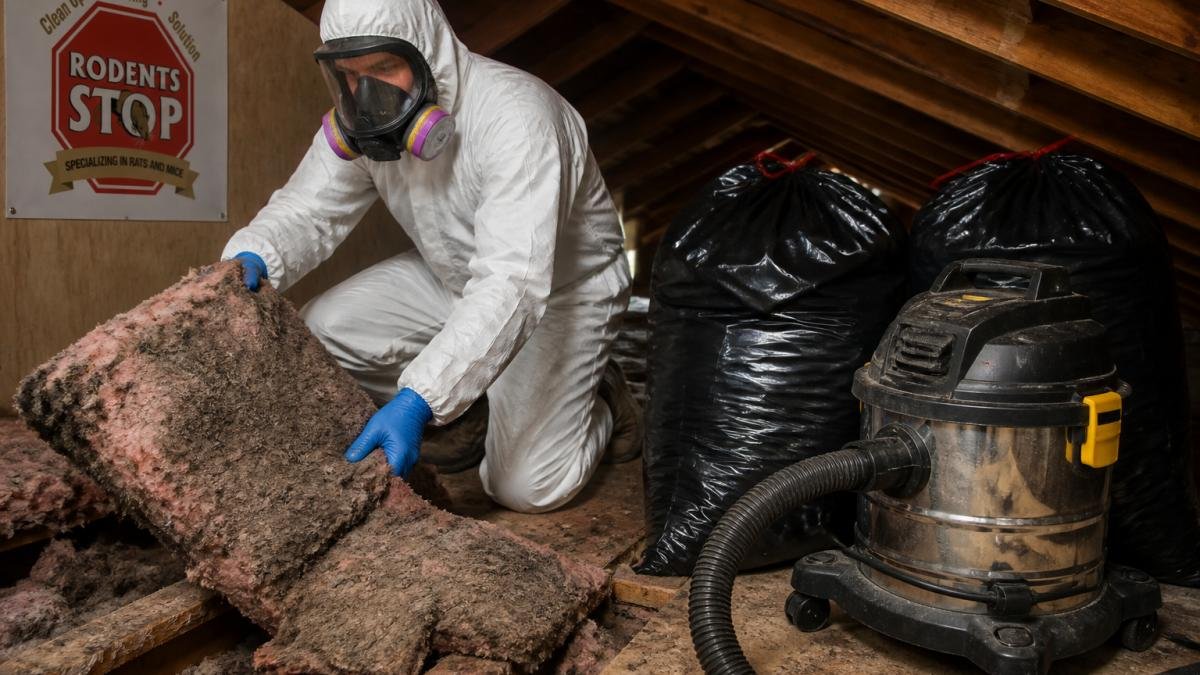
Rodent contaminated insulation removal becomes necessary when saturation passes the point where cleaning does anything useful. Insulation is porous. Urine wicks through it, and droppings break down into it.
Replacement beats cleaning in three situations:
- Heavy urine saturation where odor persists after surface cleaning
- Nesting material packed into the batts
- Compressed or damaged insulation that has lost its R-value anyway
The health side matters too. Learn about the dangers of rodent droppings in insulation, including airborne allergens and bacteria that stay in the material long after the rodents are gone. The dangers of rodent droppings in insulation include airborne allergens and bacteria that stay in the material long after the rodents are gone. Cleaning the surface of a saturated batt leaves the source in place.
When replacement is the right call, professional insulation removal and replacement restores the attic properly rather than leaving a patched-together job.
Rat Urine Odor Removal: Why the Smell Comes Back
Rat urine odor removal fails for one reason: the smell is not in the air. It is in the material. Urine crystallizes as it dries, and those crystals release odor every time humidity rises.
That is why air fresheners, ozone machines, and bowls of vinegar do not fix it. They mask or temporarily neutralize the air, then the source keeps emitting.
Professional odor and pheromone treatment targets the material itself. In practice, this means locating every saturated surface, treating it, and removing anything that cannot be salvaged. If the odor has already returned once after a DIY attempt, the reasons rodent smell stays behind usually trace back to an untreated source.
What most guides miss: pheromone trails are invisible and odorless to us, but they are the reason rodents re-enter a cleaned space. Deodorizing without addressing them cleans the nose, not the problem.
Pros and Cons of Hiring a Decontamination Service
Hiring a decontamination service is worth it when contamination has spread into insulation, HVAC access, or wall cavities. It is overkill for a single mouse caught in a snap trap, and Guardmore Pests makes that same point in its guidance on when an exterminator is worth it.
Pros:
- HEPA equipment and PPE that most homeowners do not own
- Insulation assessment by someone who knows when replacement beats cleaning
- Odor and pheromone treatment at the source
- Safe disposal of contaminated material
- Entry-point identification to reduce repeat infestations
Cons:
- Higher upfront cost than DIY supplies
- Scheduling takes longer than an afternoon of cleaning
- Not every infestation needs the full scope
If you are still weighing the decision, whether professional rodent cleanup is necessary breaks down the specific conditions that justify it.
What Drives the Cost of Professional Decontamination
Cost of professional decontamination tracks the scope of contamination, not the square footage of the house. Two attics of identical size can land far apart.
A Southern California provider lists attic cleanup separately from exclusion, which tells you the two are priced as distinct jobs.
The main cost drivers:
| Cost Factor | Why It Moves the Price |
|---|---|
| Contamination spread | More affected area means more labor and disposal |
| Insulation condition | Replacement adds material and removal costs |
| Attic access | Tight crawl spaces slow the work |
| Odor severity | Saturated surfaces need deeper treatment |
| Entry-point count | More sealing work extends the job |
| Property type | Commercial and multi-unit jobs scale up |
For a full breakdown of what each service tier costs, see the rodent cleanup cost guide.
Book a Rodent Cleanup Assessment for Your Property
The hard part is not deciding that contamination needs attention. It is knowing how far it has spread before you commit to a scope.
That is the gap we close. Rodent cleanup experts inspects the affected areas, identifies entry points, and builds a cleanup plan around what your property actually needs. Our services include droppings and nesting removal, contaminated insulation removal, HEPA vacuuming, deep cleaning and sanitizing, odor and pheromone treatment, and insulation replacement.
We work with homeowners, landlords, and property managers across Los Angeles, Ventura, San Bernardino, Riverside, and Orange Counties.
Get started with Rodent cleanup experts and get a cleanup plan built around your property’s condition.
Frequently Asked Questions
When should you hire a professional to clean up rodent droppings?
Hire a professional when droppings are widespread, when rodents have reached insulation or HVAC systems, or when the odor persists after cleaning. The CDC advises contacting a professional specifically when rodents have accessed heating and cooling ventilation systems, because contamination spreads through ductwork. Large accumulations, droppings in crawl spaces, and any situation involving dried droppings that could become airborne also justify professional rodent decontamination rather than DIY cleanup.
Can I clean rodent droppings myself?
Small, contained amounts can be handled with gloves, a spray bottle to wet the droppings first, and disinfection afterward. A single mouse caught in a snap trap may not require professional intervention. The limits appear with volume: contaminated insulation, soaked subflooring, and ductwork need equipment most homeowners do not have. If droppings are spread across an attic or crawl space, professional rodent droppings cleanup is the safer route.
How do professionals remove rat urine and odor?
Effective rat urine odor removal targets the source, not the air. Pros remove soaked materials, HEPA-vacuum the affected surfaces, apply sanitizers that break down uric acid crystals, and treat pheromone trails that draw new rodents in. Masking agents fail because the residue stays in porous wood and insulation.
How long does rodent decontamination take?
Most single-area jobs finish in one to two days, depending on contamination depth. Attics with rodent contaminated insulation removal take longer because the material must be bagged and hauled out before sanitizing begins. Larger properties or multiple affected zones can run several days. Scheduling matters too: cleanup should follow exclusion work, or rodents return to the same entry points and undo the sanitation.
