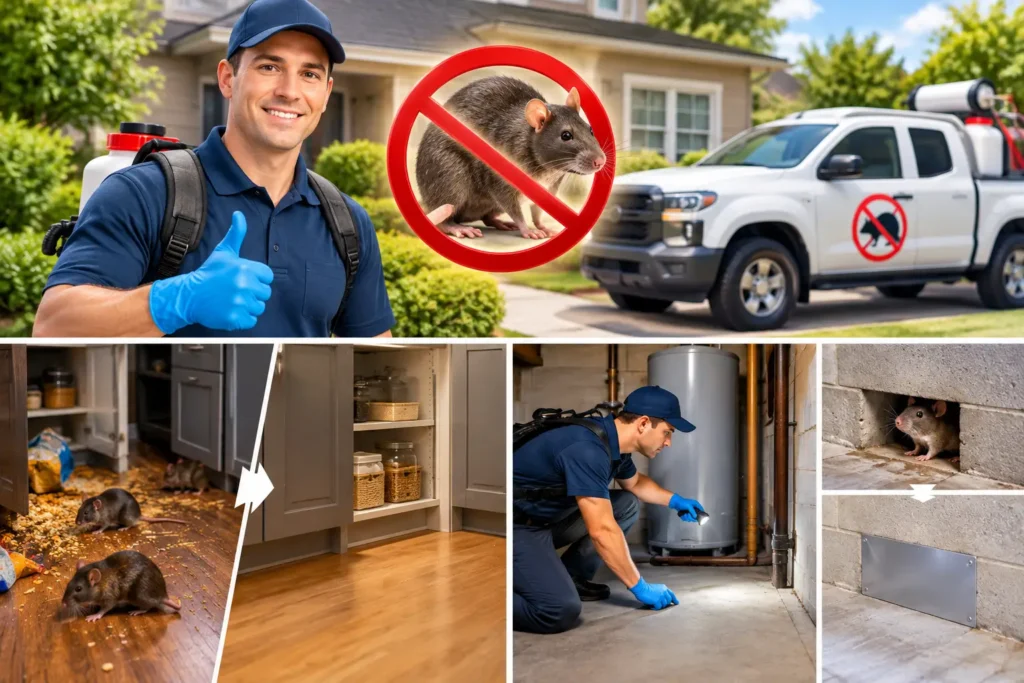
A rat problem is not resolved when the scratching stops. Safe rodent control must address what rodents leave behind: droppings in the attic, urine odor in the crawlspace, damaged insulation, nesting debris, and openings that allow the problem to return. For homes, apartments, warehouses, and other buildings, the goal is not simply to remove rodents. The goal is to restore a clean, sanitary property without introducing unnecessary risks to children, pets, tenants, or employees.
What Safe Rodent Control Actually Means
Safe rodent control is a complete approach that uses poison-free methods, removes contamination correctly, and closes the access points rodents use to enter a structure. It recognizes that rodent activity is both an active infestation issue and a cleanup issue.
A trap placed in a garage may help reduce activity, but it does not remove rat droppings from attic insulation or eliminate urine odors inside wall cavities. Likewise, a basic cleaning service may remove visible debris without identifying where rodents entered or whether contaminated materials remain beneath the surface.
The safest long-term solution combines inspection, controlled removal, professional sanitation, odor treatment, and exclusion work. Each part matters. Skipping one often leaves property owners dealing with lingering odor, recurring activity, or contamination that was never fully addressed.
Why Poison-Free Methods Matter Around Occupied Properties
Many Southern California property owners want a solution that does not rely on rodent poison. That concern is practical. Homes with children and pets, apartment communities with shared spaces, schools, restaurants, warehouses, and occupied commercial buildings all require thoughtful control methods.
Poison can create complications when rodents die in inaccessible areas such as walls, attics, crawlspaces, and ceiling voids. The result may be a strong odor that is difficult to locate and remove. It can also leave property managers and homeowners with a new sanitation issue after the original rodent activity appears to have stopped.
Poison-free control focuses on identifying rodent travel patterns, using appropriate monitored control methods, and sealing entry points. The exact approach depends on the property. A single-family home in Los Angeles with attic activity requires a different plan than an Orange County apartment building with shared utility penetrations or a Riverside warehouse with large exterior access points.
The common principle is simple: remove the access, remove the contamination, and make the structure less inviting to rodents.
Rodent Droppings and Urine Are Not a Basic Cleaning Job
Rat and mouse droppings can be scattered across insulation, stored belongings, ducting, framing, crawlspace soil, and utility areas. In heavily affected attics, contamination may be hidden under layers of insulation or inside nesting material. Odor often remains after visible droppings are removed because urine can absorb into porous surfaces.
Sweeping, dry vacuuming, or disturbing large amounts of droppings can spread contaminated dust through the area. This is why attic and crawlspace cleanup should be handled with controlled procedures, proper containment, and equipment suited to contaminated materials.
Professional cleanup generally begins with an inspection of the affected areas. The inspection should identify the extent of droppings, urine staining, nesting debris, damaged insulation, odors, and rodent entry points. It should also determine whether contamination has reached HVAC-adjacent areas, wall cavities, storage spaces, or other parts of the building.
Once the scope is clear, contaminated debris and insulation can be removed as needed. The remaining surfaces are cleaned and sanitized, then treated to address persistent rodent odor. This is especially important in attics and crawlspaces, where a property owner may not see the contamination but can still smell it inside living or working areas.
Attic Contamination Can Affect the Rest of the Property
An attic gives rodents quiet shelter, easy nesting material, and access to wiring, ducting, and insulation. It is also one of the most common places for an infestation to go unnoticed until an odor develops, scratching is heard at night, or a ceiling stain appears.
Contaminated insulation is a frequent problem. Rodents tunnel through it, deposit droppings, urinate, and build nests. In some cases, insulation can no longer be reasonably cleaned because the contamination is widespread. Removal and replacement may be the more responsible option.
The trade-off is straightforward. Spot cleaning can be appropriate for a limited, isolated issue. When droppings, nesting debris, or urine contamination extends across broad areas of an attic, partial cleaning may leave odor sources behind. A professional inspection helps determine which approach fits the actual condition rather than assuming every attic needs the same service.
Property owners should also consider the source of the problem. Roofline gaps, damaged vents, open construction joints, utility penetrations, and poorly sealed access areas are common pathways. Cleaning an attic without closing these access points can lead to repeat contamination.
Crawlspaces Need a Different Kind of Attention
Crawlspaces are difficult to inspect, poorly lit, and often neglected until a strong odor reaches the home or building above. Rodents may enter through foundation vents, gaps around pipes, damaged screens, or openings near additions and utility lines.
Because crawlspaces can contain vapor barriers, exposed soil, insulation, plumbing, and electrical components, cleanup requires careful planning. Rodent droppings and nesting debris may be spread along travel routes rather than concentrated in one visible nest. Urine odor can also remain trapped in wood framing and insulation.
A proper crawlspace sanitation plan considers access, contamination levels, affected materials, odor conditions, and entry-point repairs. It should not be treated as a quick debris removal task. The work must protect the property while addressing the conditions that made the crawlspace accessible in the first place.
Safe Rodent Control Requires Exclusion Work
Rodent exclusion is the prevention side of safe rodent control. It means finding and sealing gaps that allow rats and mice to enter. These openings can be surprisingly small and may exist at rooflines, eaves, vents, plumbing penetrations, garage edges, crawlspace vents, and utility connections.
Effective exclusion is not just applying material to a visible gap. The repair needs to account for the condition of the surrounding structure and the way rodents travel. If one opening is sealed while nearby access points remain open, rodents may simply move to another route.
For multi-unit properties and commercial buildings, exclusion requires a broader view. A tenant may report rodent activity in one unit while the actual entry point is near a shared utility chase, roof access area, loading zone, or exterior service line. The inspection should follow the evidence, not just the complaint location.
When to Call a Professional Cleanup Team
A few signs suggest that professional help is the safer choice: repeated rodent activity after prior control efforts, persistent urine odor, droppings in insulation or duct-adjacent spaces, contamination in a crawlspace, damaged attic insulation, or dead-rodent odor coming from an inaccessible location.
Landlords and property managers should act promptly when contamination affects tenant areas or common building systems. The same applies to facility managers responsible for schools, offices, warehouses, and government buildings. Delaying cleanup can allow odors, damage, and sanitation concerns to become more extensive and more disruptive.
Rodent Cleanup Experts provides professional cleanup, sanitation, deodorization, contaminated insulation removal, and entry-point sealing throughout Los Angeles, Ventura, Orange, Riverside, and San Bernardino counties. Our work is focused on the damage rodents leave behind and the practical steps that help prevent a return.
If you have droppings in an attic, a contaminated crawlspace, or a rodent odor that will not go away, schedule a professional inspection at 833-END-RATS (833-363-7287). A clear inspection and a complete cleanup plan can replace uncertainty with a safer, cleaner property.