Table of Contents
- 1. Scratching and Rat Noises in Walls at Night
- 2. Rat Droppings Near Walls: Where to Look and What They Mean
- 3. Gnaw Marks, Rub Marks, and Other Physical Signs of Rat Infestation in Walls
- 6. Is It a Rat or Mouse in Walls? How to Tell the Difference
- 7. How to Get Rid of Rats in Walls: Safe Inspection and Next Steps
- Conclusion: When to Call a Professional for Wall Rat Infestation
- Frequently Asked Questions
Last Updated: October 15, 2026
1. Scratching and Rat Noises in Walls at Night
Hearing scratching, scurrying, or rustling inside a wall at night is one of the most common signs of rat infestation in walls, and it is usually the first clue homeowners notice. Rats are nocturnal, so activity peaks after dark when the house is quiet and the sounds carry through the wall cavity.
The noises themselves tell you something. Light, fast scratching often means movement inside the cavity. Heavier thumping or running noises point to a larger body moving through a wider space, such as an attic or crawl space behind the wall.
Ruling Out Plumbing, HVAC, and Building Movement
Not every wall noise is a rat. Before you assume an infestation, work through the other common sources:
- Water pipes. Copper supply lines tick and knock as hot water expands them, and drain lines gurgle after a fixture runs. Pipe noise usually follows a trigger, a shower, a flush, a dishwasher cycle, and stops within minutes.
- HVAC ducts. Flex duct can slap against a stud when the blower kicks on, and metal duct expands with a sharp ping. This noise tracks the thermostat, not the clock.
- Water hammer. A single loud bang right after a faucet or appliance valve closes is a pressure shock in the plumbing, not an animal.
- Building movement. Wood framing creaks and pops as temperature and humidity shift, most often in late afternoon or early morning rather than the middle of the night.
- Settling and expansion. Gutters, siding, and roof panels can tick against fasteners during rapid temperature change.
What Rat Noise Actually Sounds Like
Rat activity has a signature that the mechanical sources above do not share:
- It repeats in the same location night after night, usually within an hour or two of lights-out.
- It includes scratching, light chewing, or the rustle of nesting material, not just a single knock.
- It moves along a line, a run, rather than staying at one fixed point.
- It often pairs with a faint musky odor or droppings below the same wall.
We tell homeowners in Los Angeles, Ventura, San Bernardino, Riverside, and Orange Counties to listen for three things: timing, location, and pattern. Sounds that repeat in the same spot every night for several nights rarely come from a one-off event.
Rats follow the same travel routes night after night. If you can trace the sound to a consistent spot, you have likely found a run, which narrows down where to inspect next.
If the noise only happens when water runs or the air handler cycles, treat it as a mechanical issue first. If it happens on its own schedule, in the same spot, every night, treat it as a possible rat run until you prove otherwise.
2. Rat Droppings Near Walls: Where to Look and What They Mean
Rat droppings near walls are the most reliable sign of rat infestation in walls because rodents hug edges rather than crossing open floor. Check along baseboards, behind appliances, inside cabinets, and on ledges where the wall meets the ceiling.
Fresh droppings look dark and soft. Older ones dry out and lighten. Finding them in clusters along a wall tells you the area is an active travel route, not a random visit.
Look with a flashlight and gloves. Do not sweep or vacuum droppings before you have a plan, since disturbing dried waste can release particles into the air. A careful visual inspection first saves you a second cleanup later.
3. Gnaw Marks, Rub Marks, and Other Physical Signs of Rat Infestation in Walls
Gnaw marks and greasy rub marks are physical evidence that rats are using a wall as a highway.
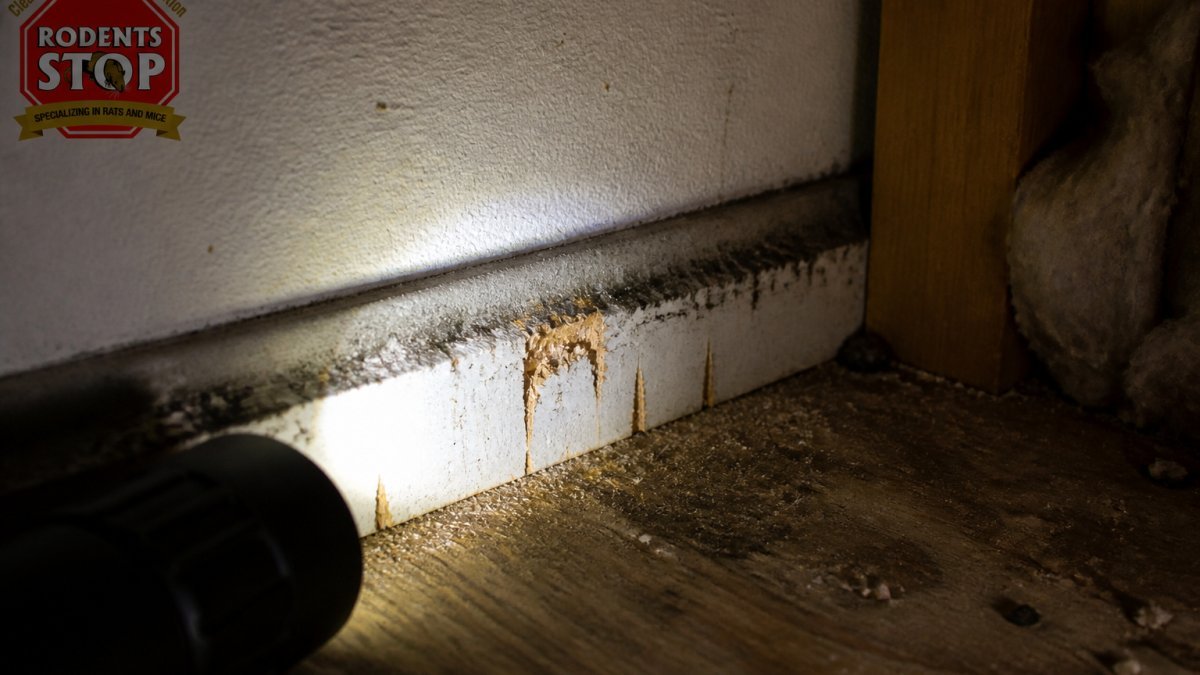
(/best-way-to-clean-rat-urine/), droppings, and nesting debris, and it tends to concentrate in closed spaces like wall cavities and attics.
Odor is also a useful tracking tool. A smell that is strongest near one outlet, vent, or baseboard points toward the source. If the odor lingers after cleaning, the contamination is likely inside the wall or above the ceiling, not on the surface.
We have walked properties where the smell returned within days of a surface wipe-down. Odor treatment only holds when the source material is removed first.
6. Is It a Rat or Mouse in Walls? How to Tell the Difference
Telling a rat from a mouse comes down to size, droppings, and sound. Rat droppings are noticeably larger and thicker than mouse droppings, and rat noises are heavier, with more thumping and less constant light scratching.
| Evidence | Rat | Mouse |
|---|---|---|
| Dropping size | Larger, capsule-shaped | Small, rice-sized |
| Noise | Thumping, heavy running | Light, rapid scratching |
| Rub marks | Prominent, greasy | Faint or absent |
| Entry gap | Wider gaps and holes | Gaps the width of a pencil |
| Nest material | Coarse shredded debris | Fine, soft shredded material |
Size is the fastest tell. A mouse can slip through a gap far smaller than a rat needs, so the size of a chewed opening often matches the animal using it.
7. How to Get Rid of Rats in Walls: Safe Inspection and Next Steps
Knowing how to get rid of rats in walls starts with a safe, methodical inspection, not a trap. The goal of the first pass is to confirm activity, map it, and avoid contaminating the air you breathe. Follow these steps and stop if you find heavy contamination or live rodents:
- Gear up first. Wear nitrile gloves, an N95 or better respirator, and eye protection before you open anything. Rodent waste carries bacteria and allergens, and dried droppings release fine particles when disturbed.
- Work in daylight with a flashlight. Avoid dark, enclosed spaces alone, and never crawl into a tight attic or crawl space without a second person nearby.
- Inspect in a fixed order. Start at the exterior, then move inward:
- Exterior: gaps around pipes, vents, rooflines, dryer vents, and the sill plate.
- Garage and utility rooms: behind the water heater, washer, and HVAC closet.
- Kitchen and pantry: behind the refrigerator, stove, and dishwasher, and along the toe kick.
- Baseboards and wall-to-floor junctions throughout the home.
- Attic-to-wall junction and any accessible wall cavity opening.
- Photograph every sign. Include something for scale, a coin or a tape measure, next to droppings, gnaw marks, and rub marks.
- Log what you find. A simple evidence log with date, location, and type of sign turns a pile of photos into a timeline.
- Do not patch openings yet. Sealing before interior activity stops traps rats inside the cavity and makes the source harder to locate.
- Do not vacuum or sweep dry droppings with a standard vacuum. It pushes contaminated dust into the air you breathe. HEPA equipment and proper protective gear are the minimum for safe removal.
Tracking Severity Over Time
A single dropping tells you a rat passed through. A pattern tells you whether the problem is growing, stable, or already addressed. Use the log to track:
- New droppings appearing along the same run within 24 to 48 hours, active, ongoing activity.
- Fresh gnaw marks with light-colored edges and no dust in the grooves, recent chewing.
- New rub marks that are still tacky or dark, recent traffic.
- Odor intensity rising in one area, likely a nest or accumulated waste nearby.
- Noise frequency shifting from occasional to nightly, activity is increasing.
If signs stop after exclusion work but odor lingers, the source material is still inside the wall and needs removal, not just sealing.
What Happens After Rats Are Confirmed in a Wall
Once activity is confirmed, the typical sequence is:
- Inspection and scope. A technician maps entry points, run lines, and contaminated zones.
- Exclusion. Gaps around pipes, vents, and rooflines are sealed with rodent-resistant materials. This step comes before or alongside removal so new animals cannot enter.
- Removal. Trapping or other removal methods are used inside the cavity and along known runs.
- Cleanup. Droppings, urine-soaked insulation, and nesting debris are removed, not spot-cleaned. HEPA vacuuming, sanitizing, and odor treatment follow.
- Insulation replacement. Contaminated insulation is replaced so odor and allergens do not return.
- Follow-up. A return visit confirms activity has stopped and exclusion is holding.
Health and property risks make speed matter. Rodent waste carries bacteria and allergens, and chewed wiring inside a wall is a genuine fire concern. Wall damage rarely stays cosmetic.
Never vacuum or sweep dry droppings with a standard vacuum. It pushes contaminated dust into the air you breathe. HEPA equipment and proper protective gear are the minimum for safe removal.
A confirmed wall infestation is a three-part job: exclude, remove, and clean. Skipping any one of the three usually means the signs come back within weeks.
Conclusion: When to Call a Professional for Wall Rat Infestation
Once you have confirmed rats inside a wall, the cleanup is usually the harder half of the job. Droppings, urine-soaked insulation, and nesting debris sit in spaces most homeowners cannot safely reach, and surface cleaning does not remove the source of the odor.
That is the work Rodent cleanup experts handles. Our team provides rodent infestation cleanup, including removal of droppings and nesting materials, contaminated insulation removal, HEPA vacuuming, deep cleaning and sanitizing, odor and pheromone treatment, and insulation replacement.
If you have found signs of rat infestation in walls at your property, get started with Rodent cleanup experts and restore the space to a clean, sanitary condition.
Frequently Asked Questions
What are the signs of rats living in your walls?
The clearest signs include scratching and scurrying noises at night, dark droppings along baseboards, gnaw marks on wood or wiring, greasy rub marks on walls, and a stale, ammonia-like odor. You may also find shredded insulation or nesting materials in the wall cavity. Seeing multiple signs together strongly suggests an active rat infestation in walls. A professional inspection can confirm the extent and identify entry points.
What do rats in walls sound like at night?
Rats in walls typically produce scratching, scurrying, and running noises, especially after dark when they are most active. You might also hear rustling, squeaks, chirps, or hisses. These sounds often come from inside the wall cavity or near the attic. If the noise is a steady hum or knocking, it could be plumbing or HVAC instead. Rats tend to create irregular, rapid scratching sounds that move along the wall.
Can you smell rats inside your walls?
Yes. A rat infestation often produces a stale, musky, or ammonia-like odor that becomes stronger in enclosed spaces like walls or attics. The smell comes from urine, droppings, and pheromones. If the odor is very strong, it may indicate a larger infestation or a dead rodent. Proper cleanup and odor treatment are needed to remove the source, not just mask the smell.
How can you tell if the noise in your wall is a rat or a mouse?
Rats are larger and produce louder scratching and scurrying sounds. Mice make lighter, faster rustling noises. Rat droppings are about the size of a grain of rice or larger, while mouse droppings are smaller. Rub marks from rats are more prominent. If you are unsure, a professional can inspect the wall cavity and identify the rodent based on evidence like droppings, tracks, and gnaw marks.