Table of Contents
- Rodent Cleanup Cost in 2026: What Shapes the Final Bill
- Initial Inspection vs. Follow-Up Visits: How Pricing Builds
- Sanitizing Attic After Rat Infestation: Scope and Pricing
- Attic Insulation Replacement Cost After Rodent Damage
- Rodent Odor Removal Services Cost: Why It Is Separate
- Rats vs. Mice, Emergency Calls, and Property Size Factors
- DIY vs. Professional Cleanup and Health Hazard Protocols
- Insurance Coverage, Air Quality Testing, and Long-Term ROI
- Frequently Asked Questions
Last Updated: September 8, 2026
Rodent cleanup costs vary dramatically depending on whether you need simple trapping or full-scale biohazard restoration, and the cost of rodent cleanup services 2026 reflects that range. The cost of rodent cleanup services 2026 is shaped less by the extermination itself and more by the sanitation, insulation replacement, and odor removal that follow. This guide breaks down exactly where your money goes and how to avoid overpaying.
The most common mistake is assuming pest control and rodent cleanup are the same service. Trapping removes the animals; professional cleanup addresses the contamination they left behind, including droppings, urine-soaked insulation, nesting materials, and the health hazards those create. Below, we walk through each cost driver so you can compare quotes with confidence.
Rodent Cleanup Cost in 2026: What Shapes the Final Bill
Rodent cleanup pricing is not a flat fee because every infestation presents a different scope of work. The main cost drivers are infestation severity, property size, materials contaminated, and whether structural sealing is required.
A small, contained mouse problem in a garage will cost far less than a roof rat infestation that has colonized an entire attic. Property size matters because larger spaces require more labor hours, materials, and extensive sanitation protocols. Whether droppings have spread into wall cavities or HVAC ductwork also escalates the final bill.
The cheapest quote is not always the best value. A low-priced cleanup that skips insulation removal or fails to seal entry points often leads to reinfestation, meaning you pay twice for the same problem.
Initial Inspection vs. Follow-Up Visits: How Pricing Builds
Most professional rodent cleanup projects begin with an initial inspection, where a technician assesses the contamination scope and identifies entry points. This assessment determines whether you need basic sanitation or a full restoration project.
Follow-up visits are typically built into the pricing structure when the job requires multiple phases. A severe attic contamination may need one visit for droppings and nest removal, a second for deep cleaning, and a third for insulation replacement and structural sealing. This phased approach helps you evaluate whether a quote reflects the complete job.
The key question to ask any provider is whether the quoted price includes the full scope or whether follow-up visits are billed separately. Service contracts for ongoing monthly maintenance are a separate line item, distinct from the one-time cleanup project.
Sanitizing Attic After Rat Infestation: Scope and Pricing
Sanitizing an attic after a rat infestation is the most involved and expensive phase of rodent cleanup. It requires removing contaminated insulation, HEPA vacuuming all surfaces, and applying disinfectants that neutralize bacteria, allergens, and pathogens.
The cost of sanitizing attic after rat infestation depends heavily on the contamination level and attic size. Professionals wear protective gear and respirators because disturbing rodent waste can aerosolize hazardous particles. The work involves treating every area rodents touched, including rafters, ductwork, and wall cavities.
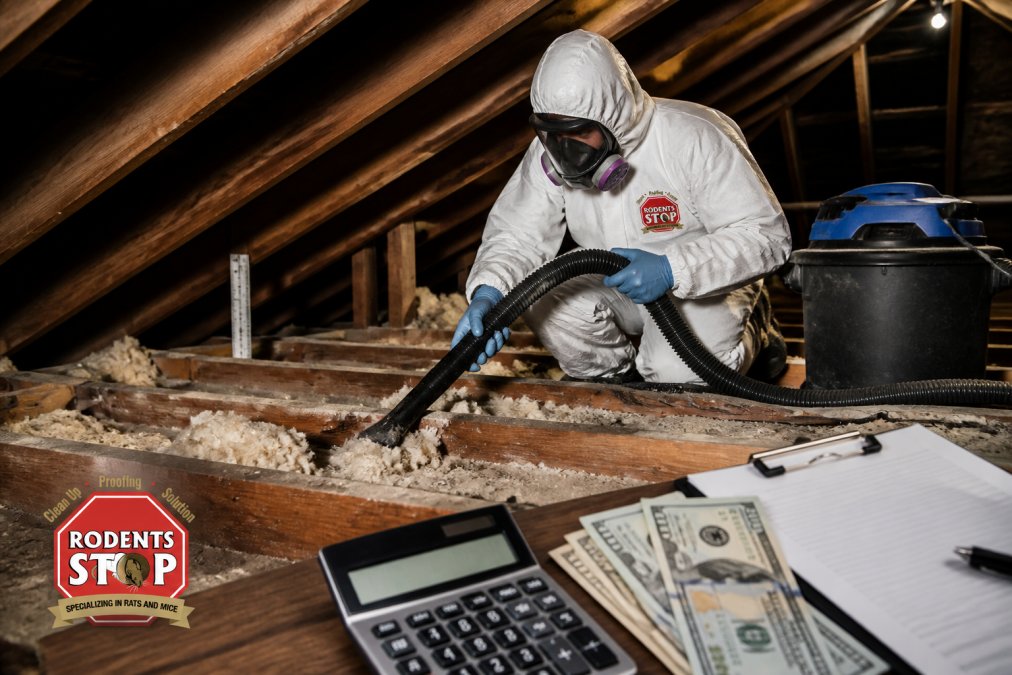
This phase is where DIY attempts fall short. A regular vacuum and bleach cannot address contamination that has soaked into insulation or settled into hidden crevices. Professional protocols exist because the health stakes are real, particularly around hantavirus prevention. For severe cases, a full rodent infestation cleanup service is the only way to ensure every contaminated surface is properly treated and the space is safe to occupy again.
Attic Insulation Replacement Cost After Rodent Damage
Once contaminated insulation is removed, it must be replaced, and this is often the single largest line item in a rodent cleanup bill. The attic insulation replacement cost after rodent damage depends on attic square footage, insulation type, and the R-value required for your climate zone.
Blown-in fiberglass and spray foam are common choices, each with different material and labor costs. The contaminated insulation is treated as hazardous waste because it contains rodent urine, feces, and nesting debris, so disposal follows specific sanitation protocols rather than standard trash pickup.
Ask your cleanup provider to coordinate insulation removal and replacement in a single project. When one team handles both phases, you avoid the gap where rodents can re-enter before new insulation is installed.
Rodent Odor Removal Services Cost: Why It Is Separate
Rodent odor removal is frequently quoted as a separate service because it requires different equipment and treatments than basic sanitation. The smell persists because pheromones and oils soak into wood, drywall, and insulation, and standard cleaning does not break those compounds down.
Professional odor removal uses enzyme treatments and specialized disinfectants that neutralize the source rather than masking it. In severe cases, affected drywall or wood may need to be sealed or replaced. This is why the rodent odor removal services cost is distinct from general cleanup pricing.
If you have had an odor for weeks and household cleaners have not helped, the contamination has likely penetrated porous surfaces. That is where professional treatment is not optional but necessary.
Rats vs. Mice, Emergency Calls, and Property Size Factors
The type of rodent involved significantly changes the cleanup equation. Roof rats and house mice behave differently, and the damage they cause varies in scale and location.
Rats are larger, cause more structural damage, and tend to nest in attics and walls, requiring more extensive cleanup. Mice breed rapidly and can contaminate large areas quickly, but their smaller size means less individual damage. Infestation severity and duration matter more than species alone.
Emergency call-outs for active infestations carry different pricing than routine scheduled work. If rodents have damaged wiring or HVAC components, the urgency increases and so does the cost. Property size remains a constant factor, with larger properties requiring more labor and materials.
| Cost Factor | Impact on Price | Notes |
|---|---|---|
| Infestation severity | High | Contamination depth drives scope |
| Property size | High | More square footage, more labor |
| Rodent type | Medium | Rats cause more damage than mice |
| Insulation replacement | High | Often the largest single cost |
| Emergency call-out | Medium | Urgency adds a premium |
| Structural sealing | Medium | Prevents reinfestation |
DIY vs. Professional Cleanup and Health Hazard Protocols
The decision to handle rodent cleanup yourself versus hiring a professional hinges on understanding the health hazards involved. The primary risk isn’t the rodent itself, but the dried urine, feces, and saliva left behind. When disturbed, these materials can aerosolize and become inhalable, a direct route for pathogens like hantavirus, leptospirosis, and salmonellosis.
The DIY Assessment Checklist
Before you consider a DIY approach, perform a rigorous assessment. Professional remediation is strongly advised if you answer ‘yes’ to any of the following:
- Is the infestation in an attic, crawlspace, or wall cavity (areas with insulation or limited ventilation)?
- Has the infestation been present for more than a few days, indicated by a large volume of droppings or a persistent odor?
- Is there any sign of urine staining on wood, drywall, or insulation?
- Do you have any pre-existing respiratory conditions like asthma or a compromised immune system?
- Are there children, elderly individuals, or pets in the home who could come into contact with contaminated areas?
If the problem is a fresh, small, and contained mouse issue in a non-porous area like a garage floor, a DIY approach with strict protocols may be sufficient. For any scenario involving porous materials or long-term contamination, the risk of exposure is too high.
The Professional Protocol: A Step-by-Step Breakdown
Professional cleanup is a systematic process designed to eliminate hazards, not just visible mess. A standard protocol includes:
- PPE and Respiratory Protection: Technicians wear Tyvek suits, boot covers, and gloves. Critically, they use a respirator with a P100 filter, not a standard N95 mask, because P100 filters are rated to capture the sub-micron particles that can carry pathogens.
- HEPA Vacuuming: A vacuum with a High-Efficiency Particulate Air (HEPA) filter is used on all surfaces. This is non-negotiable. A standard shop vacuum will blow microscopic particles back into the air, creating a more dangerous environment than before you started.
- Disinfection with Hospital-Grade Chemicals: The entire area is treated with a disinfectant registered by the EPA as effective against rodent-borne pathogens. This is not a simple bleach-and-water solution. Professional-grade chemicals are designed to break down the uric acid crystals and other organic matter that bleach cannot fully neutralize on porous surfaces.
- HEPA Vacuuming Again: After disinfection, the area is vacuumed again to remove any residual dust and disinfectant, ensuring the space is clean.
- Biocidal Application: In cases of severe contamination, a biocide may be applied to the sub-flooring or structural wood to kill any remaining bacteria and prevent future microbial growth.
The most common DIY mistake is using bleach on a porous surface like wood or drywall. Bleach cannot penetrate porous materials to kill pathogens that have soaked below the surface, and it fails to remove the proteins that cause persistent odors. This is why professionals often recommend removing and replacing porous materials rather than attempting to clean them.
The Hidden Danger of Aerosolization
A key reason professionals wear respirators is the risk of aerosolization. Simply walking through an infested attic can disturb dried droppings and dust, sending particles into the air. The CDC’s guidance on hantavirus is clear: the virus is transmitted primarily by breathing in contaminated air. This makes a professional, contained approach the only safe option for significant infestations. A comprehensive rodent infestation cleanup service follows these exact protocols to ensure the space is fully decontaminated.
Ultimately, the choice between DIY and professional is a health risk assessment. For a small, contained problem, a careful DIY effort with a HEPA vacuum and proper disinfectant can work. For anything larger, professional cleanup is an investment in your family’s respiratory health and long-term safety.
Never use a standard household vacuum to clean up rodent droppings. The motor will aerosolize the particles, spreading pathogens throughout your home and into the air you breathe.
Insurance Coverage, Air Quality Testing, and Long-Term ROI
This is where most cost guides fall short, leaving homeowners with unanswered questions about how to pay for and validate a major cleanup. We address the three components that determine the true financial and health impact of a severe infestation.
Navigating Homeowners Insurance for Rodent Damage
The most common question is, “Will my insurance cover this?” Standard homeowners insurance policies universally exclude coverage for pest infestations, including rodents. The cost to trap and remove the animals is almost always your responsibility.
However, the story changes when you look at the resulting damage. A typical policy may provide coverage for “sudden and accidental” damage. If rodents chew through wiring, causing a fire, the fire damage is covered. If they gnaw through a PVC pipe, causing water damage, that water damage is likely covered. The key distinction is the cause: damage from continuous gnawing or nesting is a maintenance issue and is excluded, while damage from a resulting event may be covered.
Document everything. Take photos of the damage, keep receipts for temporary repairs, and get a detailed written report from your contractor. This documentation is essential if you file a claim. Filing a claim for a small amount can lead to higher premiums, so it is often not worth it for minor issues. For a major restoration project, it is worth calling your insurance agent.
The Case for Post-Cleanup Air Quality Testing
After a severe infestation, the air in your home may contain microscopic particles of rodent dander, urine, and feces, even after a thorough cleaning. This is where post-cleanup air quality testing becomes a valuable, often overlooked, investment.
A professional air quality test measures the concentration of particulate matter and allergens in the air. The results confirm that the cleanup was successful and the air is safe to breathe. This is particularly important for homes with children, elderly residents, or anyone with asthma or allergies. The test provides a documented record that the property is habitable, which is critical for landlords and property managers to protect against future liability.
Calculating the Long-Term ROI of a Complete Cleanup
The true return on investment for professional rodent cleanup is not just about eliminating the immediate problem; it is about preventing the next one. The most expensive approach is a cheap, incomplete cleanup that leaves behind contaminated materials and unsealed entry points. This almost guarantees a reinfestation and a second, more extensive cleanup within months.
A complete professional job includes:
- Thorough Sanitation: Removing all contaminated materials and neutralizing pathogens.
- Structural Exclusion: Sealing all entry points, no matter how small. A mouse can fit through a hole the size of a dime, and a rat can fit through a hole the size of a quarter.
- Habitat Modification: Advising on removing food sources and nesting sites around the property.
Consider the cost-benefit analysis for a landlord. A single tenant vacancy can cost thousands of dollars in lost rent and turnover fees. If a rodent infestation is not fully resolved, it can lead to a habitability complaint, a code violation, or a tenant breaking a lease. In this context, the cost of a thorough cleanup is a fraction of the cost of a single month of vacancy. The ROI is in protecting your property’s value, tenant relationships, and reputation.
Treating a rodent problem as a one-time pest issue is a financial mistake. The most cost-effective approach is a comprehensive solution that addresses the health hazards, repairs the damage, and prevents future entry, protecting your property’s long-term value.
Frequently Asked Questions
What is the average cost to get rid of rats?
The rodent cleanup cost varies widely based on the severity of the infestation and the size of the affected area. A simple trapping situation is different from a full-scale cleanup that includes insulation replacement and odor removal. For an accurate estimate, a professional inspection is necessary, as this determines the exact scope of work required for your property.
Is professional attic sanitation necessary after a rodent infestation?
Yes, professional sanitation is critical after rats or mice have been in an attic. Rodents leave behind droppings, urine, and nesting materials that can carry pathogens and trigger allergies. Professional sanitizing an attic after a rat infestation involves removing contaminated materials, HEPA vacuuming, and applying disinfectants. This process is different from standard cleaning and is designed to eliminate health risks and prevent re-infestation.
What factors influence the total cost of rodent cleanup in 2026?
Several factors determine the final price, including the size of the property, the severity of the infestation, and the extent of structural damage. The type of rodent matters too, as roof rats and house mice can cause different issues. Costs also rise if the job requires emergency call-out, extensive structural sealing, or full insulation replacement. The need for odor removal services is another key pricing factor, as it often requires specialized equipment and treatments.
Why is odor removal a separate cost factor in rodent remediation?
Rodent odors come from urine and pheromones that soak into wood, drywall, and insulation. Standard cleaning does not eliminate these smells. Professional rodent odor removal services cost more because they require enzyme-based cleaners, specialized fogging equipment, and sometimes the removal of porous materials that cannot be deodorized. This is a distinct phase of the cleanup process and is priced based on the affected area and the severity of the contamination.
How does the extent of insulation damage affect cleanup pricing?
Insulation contaminated by rodent urine and droppings cannot be effectively cleaned and must be removed. The attic insulation replacement cost after rodent damage depends on the square footage of the affected area and the type of insulation being installed. This is often one of the largest line items in a cleanup quote because it involves both the labor of removing the old material and the cost of the new product.
Can I clean up rodent droppings myself to save money?
Attempting a DIY cleanup can be risky. Disturbing droppings and nests can release hazardous particles into the air, and a standard vacuum is not sufficient to capture these contaminants. Professionals use HEPA filtration and follow specific sanitation protocols to protect your health. While a DIY approach may seem cheaper, improper cleanup can lead to health issues and may not address the odor or attract new rodents, leading to higher costs later.
What is included in a professional rodent cleanup and restoration service?
A full-service rodent cleanup typically begins with an initial inspection to assess the damage and identify entry points. The process includes the removal of droppings and nesting materials, disposal of contaminated insulation, HEPA vacuuming, and the application of disinfectants. It often involves structural sealing and exclusion work to prevent rodents from returning. Depending on the damage, it can also include insulation replacement and odor removal treatments. The goal is to restore the area to a clean, safe, and sanitary condition.