Table of Contents
- What Rodent Pheromones Are and How They Work in Your Home
- Common Signs of Rodent Infestation Beyond Visible Droppings
- How Long Does Rat Urine Smell Last After Infestation
- Health Risks from Prolonged Rodent Pheromone Exposure
- How to Get Rid of Rat Smell in House: Step-by-Step Cleanup
- Safe Rodent Cleanup Methods and Protective Measures
- Professional Rodent Odor Removal and Long-Term Prevention
- Frequently Asked Questions
Last Updated: October 17, 2026
What Rodent Pheromones Are and How They Work in Your Home
Rodent pheromones are chemical signals rats and mice use to communicate, navigate, find food, and mark territory. As rodents move through attics, walls, and crawl spaces, they leave urine, droppings, and saliva containing these signals.
These scent cues linger long after the infestation is gone, creating invisible pathways that persist in insulation, wiring, and building materials. Understanding them is the first step toward addressing rodent pheromones effects in house environments.
At Rodent Cleanup Experts, we’ve found most homeowners underestimate how deeply these scent markers penetrate. They absorb into porous materials like insulation, drywall, and wood, which is why standard cleaning often fails to eliminate the odor completely.
Rodent pheromones are different from the visible contamination. A home can look clean but still carry strong scent cues that attract new rodents. This is one reason why professional odor treatment goes beyond removing droppings and nesting materials.
Common Signs of Rodent Infestation Beyond Visible Droppings
Rodent droppings are obvious, but homeowners often miss the early indicators of long-term contamination.
Look for these signs of rodent infestation:
- Rub marks along walls and baseboards where rodents travel repeatedly
- Gnawed wiring, insulation, or wood in attics and crawl spaces
- Nesting materials made from shredded paper, fabric, or insulation
- Strong odor that persists even after cleaning
- Scratching or scurrying sounds in walls, especially at night
- Greasy stains on surfaces where rodents frequently walk
- Entry points around pipes, vents, or foundation cracks
A persistent, ammonia-like odor that doesn’t fade after basic cleaning means contamination has likely penetrated deeper into your home’s structure, where the long-term effects of rodent pheromones in house settings become a real concern.
Many homeowners confuse a single dead rodent smell (which fades in days) with active infestation odor (which persists for weeks or months). If the smell lingers after pest control treatment, contamination has spread through your insulation and walls.
How Long Does Rat Urine Smell Last After Infestation
What is actually in the smell. Rodent urine contains urea, ammonia precursors, proteins, and pheromone compounds.
Why persistence varies by location. The same amount of contamination behaves differently depending on where it lands:
- Non-porous surfaces such as tile, sealed concrete, metal, and glass release odor relatively quickly once cleaned and dried, often within days to a few weeks with good ventilation.
- Semi-porous surfaces such as painted drywall, unfinished wood, and grout hold residues longer and may need repeated cleaning.
- Highly porous materials such as fiberglass batt insulation, cellulose insulation, carpet padding, and upholstered furniture can retain odor compounds for months, and in heavy contamination, replacement is often more reliable than cleaning.
- Enclosed cavities such as wall voids, attic chases, and crawl spaces trap moisture and volatile compounds, slowing dissipation even when the surface looks dry.
The role of ventilation and moisture. Air exchange is the biggest variable homeowners can influence. A well-ventilated attic dries and off-gasses faster than a sealed crawl space.
What is not established. No validated timetable predicts exactly how long rodent pheromones persist in a specific home, so precise week-or-month claims warrant caution.
Practical guidance. Treat odor as a diagnostic signal, not a deadline. Lightly contaminated, well-ventilated areas may resolve within weeks; heavily contaminated insulation or enclosed cavities usually require removal of contaminated material rather than surface treatment.
Test before you treat. After cleaning, ventilate the area for several days and then check whether odor returns when the space is closed up. A returning smell usually means contamination remains in a porous material or cavity, not that the cleaning failed.
Do not mask persistent odor with air fresheners or ozone before the source is removed. Masking agents can hide the signal you need to locate remaining contamination, and ozone does not remove embedded material.
For a structured cleanup workflow that addresses scent-marked areas, see the step-by-step section below.
Health Risks from Prolonged Rodent Pheromone Exposure
Most articles blur two questions: whether rodent pheromones themselves cause long-term health effects in people, and whether rodent infestation causes health problems. The second is well documented; the first is not established in the same way. Separating them is key to understanding risk in your home.
What is well established. Rodent infestations are associated with documented health risks that do not depend on pheromones:
- Allergic and asthma effects. Rodent allergens in urine, saliva, and dander become airborne in contaminated dust and are a recognized trigger for allergic rhinitis and asthma symptoms, especially in children and sensitive adults.
- Respiratory irritation. Ammonia and other breakdown products in accumulated urine can irritate eyes, nose, and throat in poorly ventilated spaces.
- Infectious disease risk. Hantavirus is the best-known example and is transmitted primarily by inhaling dust contaminated with dried rodent urine or droppings, particularly in enclosed spaces such as cabins, sheds, and crawl spaces. Other pathogens, including Salmonella and Leptospira, are associated with contact with rodent waste and contaminated surfaces.
- Secondary risks. Rodent gnawing on wiring is a fire hazard, and contaminated dust can worsen indoor air quality.
What is not established. No body of evidence shows rodent pheromones cause specific long-term health effects in people at typical indoor concentrations. They are biologically active between rodents; in humans they are not known to act as hormones or produce documented long-term syndromes.
Exposure scenarios and how risk changes.
- Brief or incidental contact, a single sighting, a small dropping in a garage, or a short visit to a contaminated attic, generally carries low risk if you avoid stirring up dust and wash up afterward.
- Repeated exposure, ongoing occupancy of a home with active rodents, or repeated DIY cleanup without respiratory protection, raises cumulative exposure to allergens and contaminated dust and is the scenario most associated with persistent symptoms.
- Enclosed or poorly ventilated spaces, attics, crawl spaces, wall voids, and closed cabins concentrate contaminated dust and are the highest-risk settings for hantavirus and for intense allergen exposure. Disturbing these spaces without a respirator is the most common avoidable mistake.
- Sensitive populations, children, older adults, pregnant people, and anyone with asthma or a compromised immune system should avoid cleanup of heavily contaminated areas entirely.
When to seek help. Seek medical advice for flu-like symptoms, shortness of breath, or worsening asthma after exposure to rodent-contaminated spaces, and tell your provider about the exposure.
The smell is a signal, not the hazard. A persistent rodent odor means contamination is still present, which means ongoing exposure to allergens and potential pathogens. Address the source, not the scent.
For protective equipment and safe cleanup procedures, see the safety section below.
How to Get Rid of Rat Smell in House: Step-by-Step Cleanup
Getting rid of rat smell requires a systematic approach.
Step 1: Identify contaminated areas
Walk through your home and note where the smell is strongest.
Step 2: Seal entry points
Before cleaning, seal gaps where rodents entered. Use steel mesh, caulk, or foam sealant. This prevents new rodents from entering while you work.
Step 3: Ventilate the space
Open windows and doors and turn on fans to dissipate odors and reduce your exposure to contaminated dust.
Step 4: Remove contaminated insulation
Insulation that contains rodent urine, droppings, or nesting materials should be removed and replaced.
Step 5: HEPA vacuum the area
Use a HEPA filter vacuum to capture fine particles. Regular vacuums spread contamination further.
Step 6: Clean and disinfect
Spray affected surfaces with a disinfectant solution. Let it sit for the recommended time. Wipe down all hard surfaces where rodents traveled.
Step 7: Treat remaining odors
Even after cleaning, residual scent cues may remain in materials that can’t be replaced. Professional odor treatment products target these compounds directly.
Safe Rodent Cleanup Methods and Protective Measures
Safety is critical when cleaning rodent-contaminated areas. Improper cleanup can spread pathogens and increase your exposure to harmful particles.
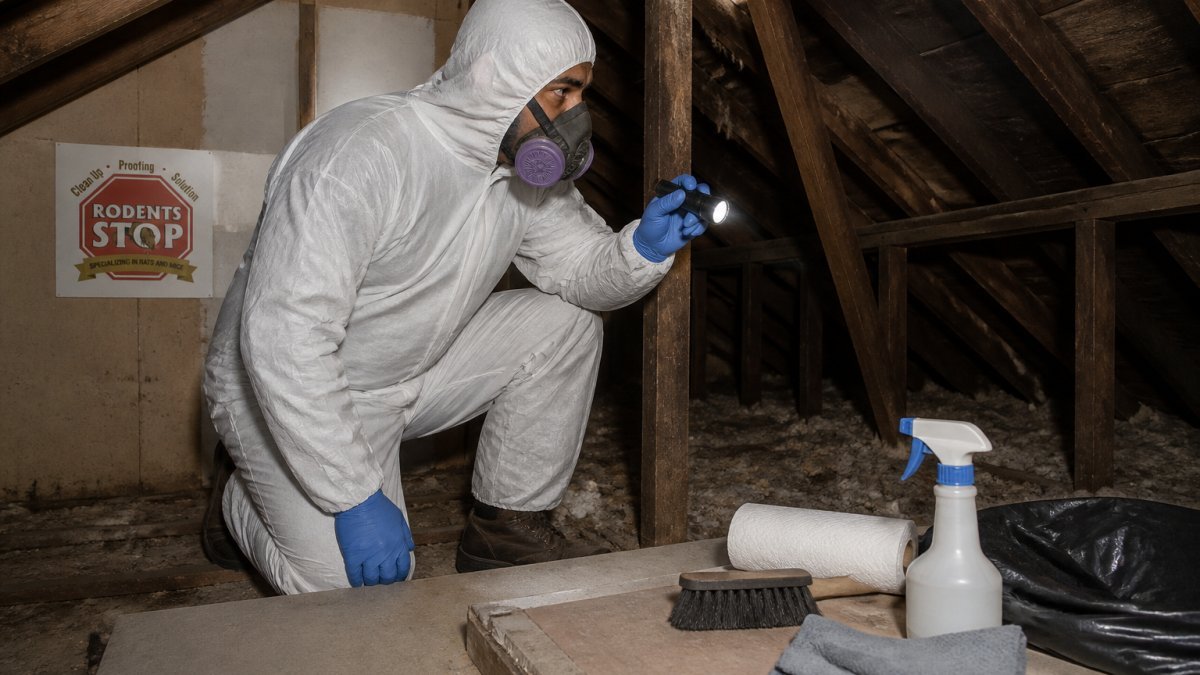
Essential protective equipment:
- N95 or P100 respirator (not a dust mask, a true respirator)
- Double nitrile gloves
- Long sleeves and pants
- Disposable coveralls or protective suit
- Eye protection
- Shoe covers or dedicated work boots
Safe cleanup procedures:
- Never dry-sweep or vacuum without a HEPA filter, this spreads contamination
- Spray urine and droppings with disinfectant before touching them
- Let disinfectant sit for 5 minutes before cleaning
- Dispose of contaminated materials in sealed bags
- Work slowly to avoid stirring up dust
- Ventilate continuously during and after cleanup
- Wash hands and change clothes after finishing
Many homeowners attempt DIY cleanup without proper equipment, increasing exposure to allergens, bacteria, and potential pathogens. Professional rodent infestation cleanup uses industrial-grade equipment and techniques DIY methods can’t match.
Using a regular vacuum on rodent droppings or urine can spread contamination throughout your home’s ventilation system. This is one of the most common mistakes homeowners make and why professional equipment matters.
Professional Rodent Odor Removal and Long-Term Prevention
When DIY cleanup doesn’t eliminate the smell, professional intervention becomes necessary, rodent pheromones effects in house settings often require specialized treatment beyond standard cleaning.
Professional rodent odor removal typically includes:
- Inspection and mapping of all contaminated areas
- Removal of contaminated insulation and nesting materials
- HEPA vacuuming of affected spaces
- Deep cleaning and disinfection of hard surfaces
- Specialized odor treatment targeting embedded scent compounds
- Identification of entry points to prevent reinfestation
Rodent Cleanup Experts provides comprehensive cleanup and odor removal services designed to address contamination at its source. Our team inspects your property, develops a plan based on the extent of contamination, and uses professional-grade equipment to restore affected areas.
Long-term prevention steps:
- Seal all gaps and cracks larger than 1/4 inch
- Keep food stored in airtight containers
- Remove clutter that provides hiding spots
- Trim branches away from roof and walls
- Maintain proper ventilation in attics and crawl spaces
- Schedule regular inspections of high-risk areas
The goal isn’t just to clean up what rodents left behind but to address the root cause and prevent their return, a combination of professional cleanup, proper sealing, and ongoing maintenance.
Persistent rodent odor signals that contamination remains in your home’s structure. DIY cleaning often misses embedded contamination in insulation and walls. Professional rodent odor removal addresses these hidden sources directly, eliminating both visible contamination and embedded scent compounds.
| Cleanup Method | Best For | Time Required | Effectiveness |
|---|---|---|---|
| Surface cleaning | Visible droppings only | 2-4 hours | Temporary odor relief |
| Insulation removal | Heavy contamination | 1-2 days | Permanent for that area |
| HEPA treatment | Dust and airborne particles | 4-8 hours | High for air quality |
| Professional odor treatment | Embedded scent compounds | 1-2 days | Most effective long-term |
| Full remediation | Complete infestation | 3-5 days | Comprehensive restoration |
Frequently Asked Questions
How long do rodent pheromones actually persist in a house after the infestation is gone?
Rodent scent cues can linger for weeks to months depending on ventilation, humidity, and the extent of contamination. Urine deposits are particularly persistent because they soak into insulation, wood, and drywall. Professional cleaning and odor treatment accelerates removal, but untreated areas may retain detectable odors for an extended period. Proper ventilation and moisture control help break down residual scent markers faster than passive air circulation alone.
Can rodent pheromones make you sick, or are the main health risks from droppings and urine?
The primary health hazards come from direct contact with urine, droppings, and contaminated dust rather than pheromones themselves. Rodent urine and feces carry bacteria, viruses, and allergens that cause respiratory illness, allergic reactions, and infections. While rodent chemical signals trigger behavioral responses in other rodents, human health effects are mainly tied to the biological contamination and airborne particles in poorly ventilated spaces. Professional cleanup addresses both the visible contamination and the odor sources.
Why is professional rodent odor removal better than cleaning it myself with bleach and a regular vacuum?
Standard household cleaning misses contamination hidden in insulation, wall cavities, and crawl spaces where rodents nest and mark territory. Regular vacuums can stir up hazardous dust and spread particles. Professional cleanup uses HEPA filtration, targeted disinfection, and specialized odor neutralization to reach areas you cannot access safely. Professionals also identify entry points and assess damage scope, reducing the risk of incomplete sanitation and future reinfestation.
How do I know if it’s safe to stay in my home during professional rodent cleanup?
Reputable cleanup services use pet-safe and human-safe disinfectants and coordinate timing to minimize disruption. Inform the team about pets, children, and anyone with respiratory sensitivity beforehand. Most cleanup can be completed in a single day or spread over a few days depending on infestation severity. Ask your service provider about ventilation protocols and which areas will be treated so you can plan accordingly. Safe rodent cleanup prioritizes your family’s wellbeing throughout the process.