Table of Contents
- Health Risks of Rodent Droppings in Insulation
- Signs of Rodent Damage in Attic Insulation
- How Rodent Waste Damages Insulation and Air Quality
- Best Way to Clean Rat Urine and Contaminated Areas
- How to Sanitize Attic After Rodent Infestation
- When to Replace Contaminated Insulation
- Preventing Future Rodent Entry and Recontamination
- Frequently Asked Questions
Last Updated: September 3, 2026
Health Risks of Rodent Droppings in Insulation
Rodent droppings in insulation pose serious health threats that extend far beyond simple contamination. When rats or mice nest in attic insulation, they leave behind fecal matter, urine, and nesting materials that harbor dangerous pathogens. These contaminants can become airborne, potentially exposing you and your family to diseases that range from respiratory infections to life-threatening conditions.
The dangers of rodent droppings in insulation are well-documented health hazards. According to CDC guidance on hantavirus and rodent-borne diseases, rodent waste can transmit multiple serious illnesses through inhalation of contaminated dust particles. Understanding these risks is the first step toward protecting your home and taking appropriate action.
Diseases Transmitted by Rodent Waste
Rodents carry and transmit several dangerous pathogens through their droppings and urine. The most serious threat is hantavirus, a potentially fatal virus that causes hantavirus pulmonary syndrome. This disease develops when a person inhales dust containing virus particles from dried rodent feces or urine.
Leptospirosis is another significant concern. This bacterial infection spreads through contact with urine-contaminated surfaces or inhalation of aerosolized particles. Symptoms include fever, chills, muscle aches, and can progress to kidney failure if untreated.
Salmonella contamination is common in rodent-infested spaces. When droppings dry and crumble, salmonella bacteria become suspended in air and can be inhaled or ingested. This causes severe gastrointestinal illness with symptoms lasting days or weeks.
Lymphocytic choriomeningitis (LCM) is a viral infection transmitted through rodent urine and droppings. While less common than other rodent-borne diseases, LCM can cause meningitis and encephalitis, particularly in pregnant women and immunocompromised individuals.
Airborne Pathogen Transmission
The greatest danger of rodent droppings in insulation comes from airborne particle transmission. When contaminated insulation degrades or is disturbed, whether through HVAC operation, foot traffic, or renovation work, microscopic particles become suspended in your home’s air.
These airborne particles are small enough to bypass your body’s natural defenses and deposit deep in the lungs. A single rodent dropping can contain thousands of viral or bacterial particles. Walking through an attic, running the furnace, or even opening an attic access hatch can trigger the release of contaminated dust that circulates through your home for hours.
The respiratory risks are compounded in homes with pets, children, or elderly residents. These populations have weaker immune systems and face higher risk of severe illness. People with asthma or chronic lung disease experience worsening symptoms when exposed to rodent-contaminated air.
Signs of Rodent Damage in Attic Insulation
Identifying rodent contamination early prevents prolonged exposure to pathogens. Look for visible rodent droppings scattered across insulation surfaces, these are typically dark, pellet-shaped, and about the size of a grain of rice. Fresh droppings appear shiny and dark; older droppings are dull and crumbly.
Urine stains create dark, greasy patches on insulation and structural surfaces. These stains often have a distinctive ammonia smell that intensifies in warm conditions. Rodent urine can soak through fiberglass batts and create permanent discoloration on wood framing beneath.
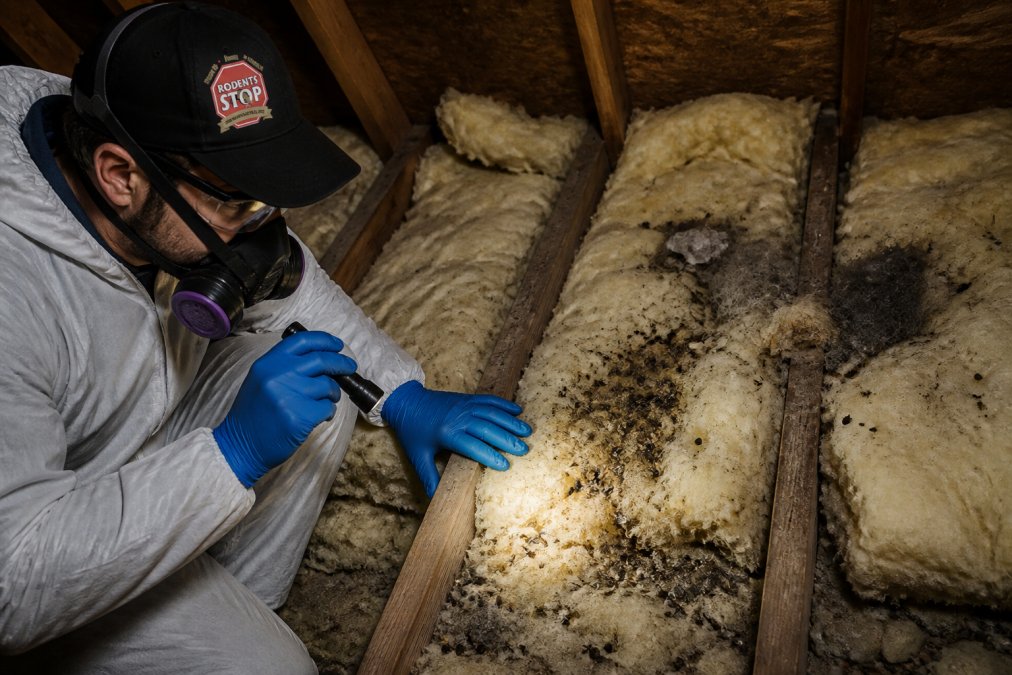
Nesting materials, shredded insulation, paper, fabric, and plant matter, indicate active or recent rodent occupation. Rodents typically build nests in corners, along joists, or inside wall cavities. The presence of nesting material combined with droppings confirms that rodents have been living in your insulation.
Greasy rub marks along beams, pipes, and insulation edges show rodent travel paths. Rodents follow the same routes repeatedly, leaving dark smudges from oils in their fur. These marks help identify how rodents are moving through your attic and where they’re nesting.
Chewed insulation, damaged vapor barriers, and gnawed electrical wiring indicate active rodent activity. Rodents constantly gnaw to keep their teeth sharp, creating safety hazards beyond contamination. Damaged wiring can cause electrical fires, while compromised vapor barriers reduce insulation effectiveness.
How Rodent Waste Damages Insulation and Air Quality
Rodent droppings and urine degrade insulation performance and compromise indoor air quality simultaneously. The dangers of rodent droppings in insulation include both immediate health risks and long-term property damage.
Urine saturates insulation fibers, reducing their ability to trap air and maintain thermal resistance. Wet insulation loses R-value, the measure of thermal effectiveness. A section of insulation contaminated with rodent urine may lose insulating capacity, forcing your HVAC system to work harder and increasing energy costs.
Fecal matter and urine create persistent odors that penetrate drywall, wood framing, and ductwork. These odors are difficult to eliminate without removing the contaminated materials entirely. Air quality suffers as pathogens and odor compounds circulate through your home’s ventilation system.
Structural and Thermal Impact
Rodents damage structural integrity by gnawing through wood framing, joists, and roof trusses. While insulation itself isn’t load-bearing, the structural components it covers can be compromised. Weakened framing may require reinforcement or replacement, adding significant costs to remediation.
Water damage compounds the problem when rodent urine saturates insulation. Wet insulation becomes heavy, sagging and pulling away from cavities. This creates gaps where conditioned air escapes, reducing HVAC efficiency and increasing utility bills in affected areas.
HVAC ductwork contamination spreads pathogens throughout your home. When rodents nest near ducts or their droppings fall into ventilation systems, every room receives circulated contamination. This is why professional remediation must include ductwork inspection and cleaning.
Best Way to Clean Rat Urine and Contaminated Areas
Cleaning rodent-contaminated insulation requires specific protocols to prevent pathogen exposure. The best way to address this problem involves proper preparation, appropriate protective equipment, and systematic decontamination.
PPE and Safety Precautions for Homeowners
Never enter a contaminated attic without proper respiratory protection. A standard dust mask is insufficient, you need an N95 or P100 respirator that fits properly and seals against your face. Fit testing ensures the respirator creates an effective barrier against airborne particles.
Wear disposable gloves, protective eyewear, and a full-body protective suit or heavy clothing that covers all skin. Rodent-contaminated areas may contain mites, parasites, and bacteria that penetrate unprotected skin. Keep contaminated clothing separate from family laundry and wash it in hot water.
Ventilate the attic continuously during cleanup. Open all vents and windows, and use fans to create negative pressure that pulls contaminated air outside rather than into living spaces. This reduces your exposure and prevents pathogens from settling on surfaces.
Avoid stirring up dust unnecessarily. Move slowly, use light misting with disinfectant rather than sweeping, and never use compressed air or leaf blowers that aerosolize contamination. Each unnecessary disturbance releases thousands of pathogen particles into the air.
HEPA Vacuuming and Decontamination Steps
A HEPA vacuum with proper filtration removes droppings and contaminated dust without releasing pathogens back into the air. Standard vacuums lack HEPA filters and spread contamination. The vacuum must have sealed containment and a HEPA filter rated to capture particles as small as 0.3 microns.
Begin by lightly misting contaminated areas with a disinfectant solution, bleach and water (1:10 ratio) or commercial disinfectant. This prevents particles from becoming airborne during collection. Allow the solution to sit for 5-10 minutes before vacuuming.
Vacuum slowly and methodically, working from the attic’s far corners toward the exit. Use HEPA vacuuming to collect all visible droppings, nesting materials, and dust. Pay special attention to corners, along joists, and around pipes where rodents concentrate their activity.
After vacuuming, spray all surfaces with disinfectant and allow them to dry completely. This kills remaining pathogens on insulation surfaces and wood framing. A second application after 24 hours provides additional assurance of pathogen elimination.
Dispose of the vacuum’s contents in sealed, heavy-duty garbage bags. Do not empty the HEPA filter into your trash, place the entire bag in an outdoor dumpster or arrange professional disposal. Contaminated materials should never enter your regular household waste stream.
How to Sanitize Attic After Rodent Infestation
Complete attic sanitization requires more than surface cleaning. The dangers of rodent droppings in insulation necessitate thorough decontamination of all affected surfaces, materials, and air systems.
Begin with a professional inspection to identify all contaminated areas. Rodent droppings and urine may be present in spaces you cannot see, behind insulation, inside wall cavities, and within ductwork. Thermal imaging and moisture detection help identify hidden contamination.
Remove and dispose of all heavily contaminated insulation. If droppings cover more than 5-10% of an insulation section, replacement is more effective than cleaning. Partial contamination can be cleaned, but extensive contamination requires removal to ensure complete pathogen elimination.
Sanitize all wood surfaces, beams, and structural components with appropriate disinfectant. Allow adequate drying time, typically 24-48 hours, before applying new insulation. Proper ventilation during this period prevents moisture accumulation that could support mold growth.
Clean HVAC ductwork and return air plenums where rodent droppings may have entered the ventilation system. This prevents circulated contamination from reaching living spaces. Professional duct cleaning uses specialized equipment to remove all contaminated dust and debris.
Professional Remediation vs. DIY Cleanup
DIY cleanup presents significant health risks that many homeowners underestimate. The dangers of rodent droppings in insulation include exposure to hantavirus, which can be fatal. A single mistake, removing your respirator too early, inadequate ventilation, or incomplete disinfection, can result in serious illness.
Professional remediation teams have proper equipment, training, and experience handling biohazardous materials. They understand pathogen transmission routes and implement protocols that eliminate cross-contamination. Professional rodent infestation cleanup services ensure that all contaminated materials are properly removed and disposed of, and that your home is thoroughly decontaminated.
Professional teams also identify entry points and damage that homeowners might miss. They can assess whether insulation replacement is necessary or if targeted cleaning is sufficient. This expertise prevents costly mistakes like leaving contaminated materials in place or replacing insulation without addressing underlying structural damage.
Faster completion means shorter exposure periods and faster return to normal living conditions.
When to Replace Contaminated Insulation
Determining whether to clean or replace contaminated insulation depends on contamination severity, insulation type, and the extent of structural damage.
Light contamination, scattered droppings affecting less than 5% of an insulation section, can be cleaned if the insulation is still intact and properly supported. Careful vacuuming and disinfection restore the insulation’s function without full replacement.
Moderate contamination, affecting 5-25% of an insulation area, requires careful evaluation. If the contamination is concentrated in one section, removing and replacing just that portion may be cost-effective. If contamination is dispersed throughout, full replacement is often more practical.
Heavy contamination, affecting more than 25% of insulation or involving extensive urine saturation, requires complete replacement. Saturated insulation loses thermal performance and harbors pathogens even after cleaning. Replacement prevents ongoing air quality problems and restores insulation effectiveness.
Insulation Types and Contamination Severity
Fiberglass batts are the most common insulation type and the most vulnerable to contamination. Fiberglass absorbs rodent urine readily, and the porous structure traps pathogens deep within the material. Once saturated, fiberglass batts are nearly impossible to fully decontaminate and replacement is typically recommended.
Blown-in cellulose insulation presents different challenges. The loose-fill nature means contamination penetrates throughout the material. Removing blown-in insulation is labor-intensive, but often necessary when rodent damage is extensive. New blown-in insulation can be installed after cleaning and sealing entry points.
Spray foam insulation is less vulnerable to rodent contamination because it creates a sealed barrier. However, rodents can still nest on its surface and create localized contamination. Foam insulation can typically be cleaned and sealed without replacement unless structural damage is present.
Mineral wool insulation has properties similar to fiberglass. It absorbs moisture and pathogens readily, and replacement is often the most practical solution for contaminated mineral wool. The material’s density makes it difficult to achieve complete decontamination through cleaning alone.
Preventing Future Rodent Entry and Recontamination
Prevention is far more cost-effective than remediation. After addressing contamination, sealing entry points stops rodents from returning and recontaminating your insulation.
Inspect your home’s exterior for gaps and holes larger than a quarter-inch. Rodents can squeeze through surprisingly small openings, so seal everything. Use steel mesh, caulk, or hardware cloth, materials rodents cannot chew through.
Focus on areas where utilities enter the home: where pipes, wires, and ducts penetrate walls and foundations. These are primary entry points for rodents. Seal gaps around these penetrations with expandable foam or steel mesh, then trim and caulk the edges.
Trim tree branches and vegetation away from your roof and walls. Rodents use branches as highways to access your home. Maintaining a 6-8 foot clearance around your home’s perimeter reduces rodent access routes.
Store food in sealed containers and eliminate outdoor food sources. Bird feeders, pet food left outside, and exposed garbage attract rodents. Keep trash in sealed containers and clean up fallen fruit and nuts from your yard.
Maintain your home’s exterior by repairing damaged siding, roofing, and vents. Damaged areas provide entry points for rodents. Regular maintenance prevents small problems from becoming infestations.
Consider professional rodent exclusion services that systematically identify and seal all entry points. These services often include inspection, sealing, and monitoring to ensure rodents don’t return. This approach prevents the need for future cleanup and sanitization.
The dangers of rodent droppings in insulation demand immediate, thorough action. Contaminated insulation compromises your home’s safety, air quality, and energy efficiency. While some homeowners attempt DIY cleanup, the health risks and complexity of complete decontamination often make professional remediation the safer choice. Professional rodent infestation cleanup services provide comprehensive inspection, removal of contaminated materials, HEPA vacuuming, complete sanitization, and professional insulation replacement. Our team identifies entry points to prevent recontamination and restores your attic to safe, sanitary condition. Contact us for a professional assessment of rodent damage in your home.
Frequently Asked Questions
Q: What diseases can you catch from rodent droppings in insulation?
A: Rodent droppings transmit several serious pathogens. Hantavirus causes flu-like symptoms and can lead to life-threatening respiratory illness. Leptospirosis spreads through urine and causes fever and kidney damage. Salmonella and lymphocytic choriomeningitis are also common. These diseases spread through airborne particles when droppings are disturbed, making attic contamination particularly dangerous. Avoid direct contact and use proper PPE when handling contaminated insulation.
Q: Should I remove insulation with mouse droppings?
A: Yes, heavily contaminated insulation should be removed and replaced. If droppings cover more than 10-15% of the insulation area, or if urine saturation has compromised the material’s thermal properties, replacement is the safest option. Fiberglass and blown-in insulation absorb urine and fecal matter, making thorough decontamination difficult. Professional removal ensures proper biohazard disposal and prevents pathogen spread during the process.
Q: What is the best way to clean rat urine from attic surfaces?
A: Use a HEPA-filter vacuum with proper PPE including an N95 or P100 respirator, gloves, and eye protection. First, spray affected areas lightly with a disinfectant to minimize dust. Vacuum slowly and carefully, then wipe surfaces with a bleach solution (1 part bleach to 10 parts water). Avoid dry sweeping, which releases pathogens into the air. For extensive urine damage, professional sanitization with commercial-grade decontamination is recommended.
Q: How long do rat droppings remain toxic in insulation?
A: Rodent droppings remain a biohazard for months or years in insulation. Hantavirus can survive in dried fecal matter for weeks. Bacteria and parasites persist even longer in undisturbed environments. The longer contaminated insulation sits, the greater the risk of pathogen spread through HVAC systems and air circulation. Prompt removal and sanitization reduce health risks significantly.
This article was written using GrandRanker