Table of Contents
- Why DIY Rodent Cleaning Fails: The Hidden Contamination Problem
- The Dangers of Rodent Droppings in Insulation
- Rodent Pheromone Removal Techniques: Why Bleach Is Not Enough
- The Cost of Professional Attic Cleanup vs. Repeat DIY Attempts
- 5 Reasons Your DIY Rodent Cleaning Efforts Fall Short
- Common Mistakes That Lead to Recurring Infestations
- Post-Removal Sanitation and Exclusion: Securing Your Home
- Conclusion: When to Call in Rodent Cleanup Experts
- Frequently Asked Questions
Last Updated: September 4, 2026
Why DIY Rodent Cleaning Fails: The Hidden Contamination Problem
Most homeowners assume that removing visible droppings with a vacuum and wiping surfaces with bleach solves the problem. This is why DIY rodent cleaning fails: the contamination extends far beyond what the eye can see, penetrating insulation, drywall, and HVAC systems in ways that standard household methods cannot address. At Rodent cleanup experts, we have assessed hundreds of attics across Southern California, and the pattern is always the same: the visible mess is cleaned, but the hidden contamination remains, creating health risks and persistent odors.
Rodent cleaning is the process of removing not just droppings and nests, but also the microscopic pathogens, allergens, and pheromone residues that rodents leave behind throughout an infested area. The true scale of the problem only becomes apparent once you understand that a single rodent can contaminate an entire attic space through urine, feces, and dander that settles into every porous surface. Below, we will break down exactly why store-bought solutions fall short and what actually works to restore your home to a safe condition.
The Dangers of Rodent Droppings in Insulation
Rodent droppings in insulation represent one of the most serious health hazards hidden in American homes. When rodents nest in attic insulation, they urinate and defecate directly into the fiberglass or cellulose, creating contamination zones that can harbor pathogens including hantavirus, which is transmitted through airborne particles when disturbed.
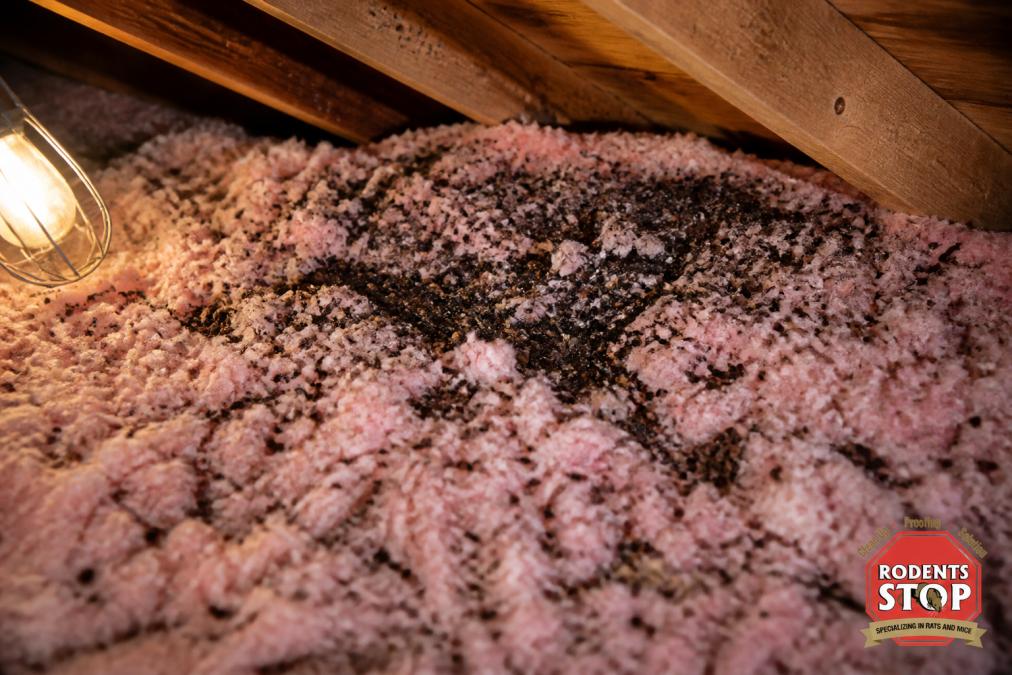
The problem compounds because insulation acts like a sponge. Urine soaks deep into the material, droppings become crushed into fine particles, and dander settles throughout. Simply removing the visibly soiled sections is insufficient because the contamination spreads laterally through the entire insulation layer. According to guidance on rodent-borne disease prevention, proper cleanup requires removing contaminated materials using protective equipment and following strict protocols to avoid stirring up infectious particles. Attempting to vacuum these areas with a household machine only aerosolizes the contaminants, pushing them further into your living space through the HVAC system. A professional rodent infestation cleanup service uses HEPA filtration and specialized equipment to safely remove contaminated insulation without spreading pathogens.
Rodent Pheromone Removal Techniques: Why Bleach Is Not Enough
Rodent pheromone removal techniques go far beyond what commercial disinfectants can achieve. Pheromones are chemical signals that rodents deposit through urine and gland secretions, and they serve as a map for other rodents to follow. If these residues remain after you clean, your home continues to broadcast an open invitation to new invaders.
Bleach and standard household cleaners simply cannot break down these oily, protein-based compounds. Professional-grade enzymatic cleaners are designed specifically to digest organic residues at the molecular level, neutralizing the pheromone trails rather than just masking them. The process also requires treating every surface rodents may have contacted, including wall cavities, floor joists, and ductwork. A common mistake is cleaning only the obvious areas while leaving pheromone deposits along baseboards and behind appliances, which is why many homes experience re-infestation within weeks of a DIY cleanup attempt.
The Cost of Professional Attic Cleanup vs. Repeat DIY Attempts
When comparing the cost of professional attic cleanup versus repeated DIY attempts, the calculation almost always favors hiring experts. However, the true cost of a failed DIY approach extends far beyond the price of a few traps and a bottle of bleach. It is a cycle of recurring expenses, escalating property damage, and a significant, often overlooked, psychological toll on the homeowner.
The Direct Financial Cycle of DIY:
A single DIY attempt is rarely a one-time purchase. The typical cycle involves:
- Initial Supplies: Snap traps, glue boards, or ultrasonic repellents, plus cleaning agents, spray foam, and steel wool. This initial outlay can easily reach $100-$200.
- The First Re-Infestation: When rodents return due to unsealed entry points or lingering pheromone trails, the homeowner repeats the process. This means buying more traps and more cleaning supplies.
- The ‘Hidden’ Damage: While the homeowner is focused on trapping, rodents are actively gnawing on electrical wiring, which creates a fire hazard. They are also soiling insulation and chewing through drywall. The cost to repair a single chewed electrical wire can be several hundred dollars, and replacing a section of drywall damaged by urine and gnawing is a multi-hundred-dollar project. These costs are rarely factored into the ‘cheaper’ DIY equation.
- The Cost of Contaminated Insulation: If a homeowner does attempt to remove soiled insulation themselves, they must pay for disposal fees, personal protective equipment (PPE), and the replacement material. A single bag of fiberglass insulation costs $30-$50, and an attic may require dozens of bags. This is on top of the physical risk of handling contaminated materials without proper training.
The Psychological Cost of Failed DIY:
The financial drain is only half the story. The mental fatigue of living with a recurring infestation is a real and significant burden that is almost never discussed. Homeowners describe a feeling of helplessness and frustration as they repeatedly clean up droppings, set traps, and hear scurrying in the walls at night. This chronic stress can disrupt sleep, strain relationships, and create a sense of being ‘under siege’ in one’s own home. The constant, low-grade anxiety of wondering where the next sign of rodents will appear takes a measurable toll on well-being. This is a cost that no DIY budget can account for, but it is often the primary driver for finally seeking professional help.
The Professional Alternative: A Single, Comprehensive Investment
A professional attic cleanup is not just a service; it is a comprehensive solution that addresses the financial and psychological burden in a single, defined engagement. The process typically involves:
- A full inspection to identify the species, the extent of contamination, and all entry points.
- Safe removal and disposal of contaminated insulation and nesting material.
- HEPA vacuuming and enzyme treatment of all structural surfaces to neutralize pathogens and pheromones.
- Professional exclusion work to seal all entry points, preventing future infestations.
- New insulation installation to restore the thermal barrier and energy efficiency of the home.
While the upfront cost of this service is higher than a single DIY trip to the hardware store, it is a finite expense. It eliminates the recurring costs of repeated attempts, prevents the expensive structural damage that rodents cause over time, and, most importantly, provides peace of mind. The value of a final, permanent solution is not just in the money saved, but in the restoration of a home to a safe, sanitary, and stress-free state.
When evaluating the cost of professional cleanup, consider the total cost of ownership for your DIY approach: the sum of all your past and future trap purchases, cleaning supplies, potential repair bills, and the intangible but very real cost of your own time and mental energy. For most, the professional route is not just more effective, it is more economical in the long run.
5 Reasons Your DIY Rodent Cleaning Efforts Fall Short
Understanding why DIY rodent cleaning fails requires examining the specific technical limitations of household approaches. Here are the five most common reasons your efforts are not working:
-
Inadequate containment: Without professional-grade HEPA filtration and negative air pressure, you spread contaminants throughout your home during cleanup. Disturbing droppings releases pathogens into the air you breathe.
-
Incomplete removal: Household vacuums cannot extract contamination from deep within insulation or porous surfaces. You remove the visible material while leaving the dangerous residue behind.
-
Ineffective disinfection: Standard cleaners do not neutralize rodent-borne pathogens or break down pheromone compounds. The biological hazard remains even after surfaces appear clean.
-
Missing hidden areas: Rodents contaminate wall cavities, ductwork, and crawl spaces that are inaccessible without professional equipment. Unaddressed areas become ongoing contamination sources.
-
No exclusion measures: Cleaning without sealing entry points guarantees re-infestation. rodent control resources from the National Pest Management Association notes that effective rodent management requires identifying and sealing all potential access points, which most homeowners lack the training to recognize.
Each of these failures compounds the others. Incomplete removal leads to ineffective disinfection, which leads to recurring infestations, which leads to more contamination. Breaking this cycle requires a comprehensive approach that addresses all five factors simultaneously.
Common Mistakes That Lead to Recurring Infestations
The most frustrating outcome of DIY rodent cleaning is watching rodents return within weeks. While the cause is often a combination of poor sanitation and unsealed entry points, a more fundamental error is treating all rodents as if they behave identically. The three most common commensal rodents in the United States, the house mouse, the Norway rat, and the roof rat, have distinct behaviors, habitats, and food preferences. A one-size-fits-all DIY approach almost guarantees failure because it ignores these biological drivers.
House mice are curious and highly adaptable. They are excellent climbers and can squeeze through gaps the width of a pencil (about 1/4 inch). They tend to establish nests close to food sources, often inside wall voids, appliance motors, or stored boxes. Their droppings are small, rod-shaped, and pointed at the ends. Because they are neophilic (attracted to new objects) to a degree, snap traps can work, but only if placed perpendicular to walls where mice travel. A common DIY error is placing traps in the open, away from the runways mice use for safety.
Norway rats are larger, burrowing animals. They are typically ground-dwellers, nesting in burrows under slabs, in crawl spaces, or in debris piles. They are cautious and strongly neophobic, new objects in their environment, like a trap, will cause them to avoid the area for days. A homeowner who checks a trap after 24 hours and finds it empty may conclude the rat is gone, when in fact the rat is simply wary. The correct approach is to place baited but unset traps for several days to allow the rat to become accustomed to them before arming the trap. Norway rat droppings are larger, with blunt ends, and are often found in scattered piles near food sources.
Roof rats are agile climbers that prefer elevated areas like attics, rafters, and trees. They are often mistaken for Norway rats, but their behavior is completely different. Roof rats are more likely to enter a home through gaps near the roofline, such as damaged vents or under loose fascia boards. They are also more prone to gnawing on wiring and structural timbers, creating a significant fire hazard. A DIYer who focuses on ground-level traps and bait stations will completely miss a roof rat infestation that is living and breeding in the attic.
The failure to identify the species leads to a cascade of errors: incorrect trap placement, wrong bait selection, and a failure to seal the specific entry points that species uses. For instance, sealing ground-level cracks will do nothing to stop a roof rat entering through a broken roof vent. A thorough inspection must first identify the species by its droppings, gnaw marks, and runways before any control strategy is implemented. This is not just a matter of convenience; it is the difference between a temporary fix and a permanent solution.
A common pattern we observe is a homeowner who has been fighting ‘mice’ for months with traps and repellents, only to discover they actually have a roof rat infestation. The traps were the wrong size, placed in the wrong locations, and the entry points were never sealed because they were all at the roofline, not at ground level.
Post-Removal Sanitation and Exclusion: Securing Your Home
Once the active infestation is resolved, the work of securing your home begins. Post-removal sanitation goes beyond surface cleaning to address the full extent of contamination, including insulation replacement, HEPA vacuuming of all affected surfaces, and enzyme treatment of structural elements. This phase also includes inspecting and cleaning HVAC systems, which can distribute rodent allergens and pathogens throughout your entire home if left untreated. For comprehensive results, a rodent infestation cleanup service ensures that every contaminated area is properly treated and restored.
Exclusion work is equally critical to preventing future infestations. Rodents can squeeze through openings as small as a quarter-inch, so a thorough inspection must identify every potential entry point. Common access routes include gaps around utility lines, damaged roof vents, uncapped chimneys, and deteriorated weather stripping on doors. Sealing these openings with appropriate materials, such as steel wool combined with caulking for small gaps and hardware cloth for larger openings, creates a durable barrier against re-entry. Property managers overseeing multiple units benefit particularly from this systematic approach, as it prevents infestations from spreading between adjacent residences.
Conclusion: When to Call in Rodent Cleanup Experts
DIY rodent cleaning fails because the problem is fundamentally more complex than most homeowners realize. The contamination extends beyond visible droppings into insulation, structural cavities, and HVAC systems, while pheromone residues continue to attract new rodents no matter how thoroughly you scrub. Professional intervention addresses these issues through comprehensive assessment, specialized equipment, and proven sanitation protocols.
Rodent cleanup experts provides professional rodent damage cleanup, sanitation, odor removal, and restoration for homes and businesses throughout Southern California. Our team handles contaminated insulation removal, HEPA vacuuming, deep cleaning and sanitizing, and odor and pheromone treatment, followed by professional replacement of damaged insulation. We also inspect affected areas to identify potential entry points, helping you reduce the risk of rodents returning. If you have attempted DIY rodent cleaning and are still dealing with odors, recurring infestations, or health concerns, get started with Rodent cleanup experts and restore your home to a safe, sanitary condition.
Frequently Asked Questions
Why is professional rodent cleanup safer than DIY methods?
Professional rodent cleanup is safer because it uses HEPA-filtered vacuums and EPA-registered disinfectants that neutralize pathogens like hantavirus. DIY attempts with a standard vacuum or bleach can stir up contaminated dust and increase your exposure risk. Professionals also identify and seal entry points, which prevents re-entry and recurring infestation, a step most homeowners miss.
Can DIY cleaning methods effectively remove rodent pheromones?
No. Standard household cleaners do not break down the pheromone trails rodents leave behind. These chemical markers signal to other rodents that the area is a safe nesting site. Professional rodent pheromone removal techniques involve specialized enzyme-based treatments that eliminate these odors at the source, preventing rodents from returning to the same location.
Why do rodent odors persist after DIY cleaning?
Odors persist because urine and droppings often soak into insulation, wood, and drywall, which are porous materials. A surface wipe-down does not remove the contamination embedded deep within these materials. Professional cleanup typically involves removing and replacing contaminated insulation, treating the underlying surfaces with odor neutralizers, and using HEPA vacuuming to eliminate the source of the smell.
What specialized equipment is needed for safe rodent waste removal?
Safe rodent waste removal requires professional-grade equipment, including HEPA-filtered vacuums to capture microscopic particles, personal protective equipment (PPE) like respirators and coveralls, and EPA-registered disinfectants effective against rodent-borne pathogens. Using household vacuums or standard cleaning supplies can aerosolize dangerous particles, leading to health risks from inhaling contaminants.
This article was written using GrandRanker