
Quick Summary
Rats chewing sealant is a common failure, because rats gnaw through caulk, foam, plastic and soft wood. The reliable fix is a physical barrier they cannot chew, such as steel wool or galvanized hardware cloth, with caulk applied over it for weather protection. Rats can pass through openings about half an inch across, so even small gaps need sealing.
- Rats can squeeze through openings about half an inch across.
- Caulk and expanding foam alone are rarely a complete fix against rats.
- Steel wool, galvanized hardware cloth and sheet metal are materials rats cannot readily chew through.
- Mesh of about one quarter inch or less stops rats effectively.
- Check repairs every few months and after heavy storms for new chew marks.
Table of Contents
- Why Rats Chew Through Standard Sealants
- How to Identify Rodent Entry Points Before You Seal
- Materials Rats Cannot Chew Through
- Best Caulk for Mice and Rats: What Holds Up
- Best Foam Sealant for Mice: Where It Helps and Where It Fails
- How to Seal Gaps to Prevent Rodents, Step by Step
- Booking a Professional Inspection and Cleanup for Your Property
- Frequently Asked Questions
How to Prevent Rats From Chewing Through Sealant
Rats can squeeze through a hole about half an inch across, which is smaller than most people expect. That is the core problem with sealant. A rat that finds a gap will chew at the material until it opens, and standard caulk and foam give way far more easily than most homeowners assume. This guide explains why rats chewing sealant is so common, how to find the entry points that matter, and which materials hold up. Rodent Cleanup Experts works with homeowners across Southern California on rodent damage and sanitation, so the steps below reflect practical experience with these problems.
Why Rats Chew Through Standard Sealants
Rats gnaw constantly to keep their teeth worn down, so they treat soft materials as something to chew through rather than something to avoid. Caulk, plastic, foam and soft wood are all easy targets. Rats can chew through caulk, plastic, foam and wood, so caulk alone is rarely a complete fix.
A common mistake is filling a gap with caulk and assuming the job is done. A rat that sees food or shelter on the other side will return to that spot and work at it.
- Caulk and expanding foam are softer than the gnawing rats can do
- Plastic and thin rubber give way quickly
- Soft wood and drywall edges are easy to widen
How to Identify Rodent Entry Points Before You Seal
Sealing without finding the real entry points wastes time. Walk the outside of the house slowly, looking low and high. Rats mostly enter at ground level, but they also use utility lines and roof edges.
Check these areas first:
- Gaps where pipes, cables or vents enter the wall
- Gaps under garage doors and around the base of siding
- Vents, eaves and attic openings
- Cracks in the foundation and gaps around exterior doors
Look for grease marks along walls, droppings near gaps, and chewed edges. If you find these signs, seal the gap with a chew-resistant material rather than caulk alone. For a deeper walkthrough, see our guide on how to identify rodent entry points in your home.
Materials Rats Cannot Chew Through
The most reliable approach is a physical barrier rats cannot chew, with sealant used only for weather protection afterward. Rats gnaw with incisors that keep growing, so the barrier has to be made of a material harder than their teeth can cut. Steel and galvanized metal meet that test. Most soft materials, including plastic, foam, rubber and wood, do not.
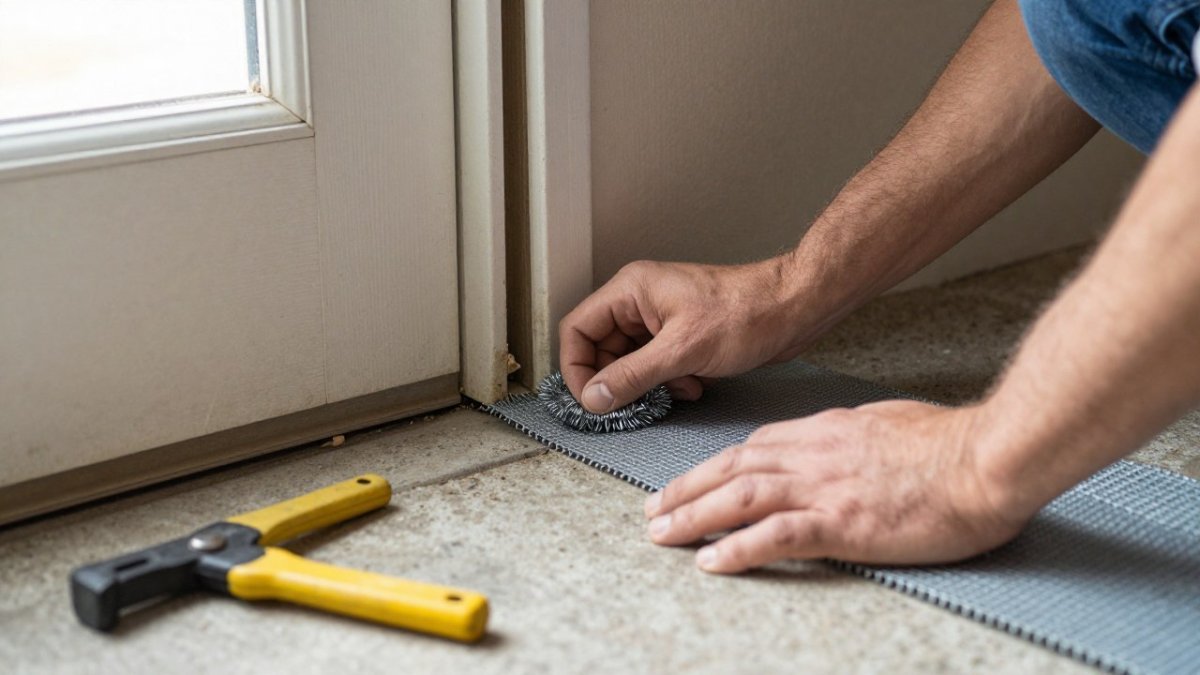
Filling small holes with steel wool and then applying caulk around it to hold it in place is a common approach. Steel wool works well for openings in the range of a few inches, and it packs tightly into irregular gaps around pipes and cables. Its weakness is that it rusts when left exposed to moisture, so it should always be covered at the surface.
For larger openings, galvanized hardware cloth is the standard choice. Mesh size matters: openings of about one quarter inch or less stop rats effectively, while wider mesh allows them to push through or chew the wire at the edges. Sheet metal and cured concrete are also commonly used materials that rats cannot readily chew through. Sheet metal flashing is useful near siding and trim, where a flat metal face can be bent around the edge of a gap.
Materials to compare when choosing a barrier:
- Steel wool: Best for packing small or irregular holes. Covers fast, but it rusts outdoors unless capped with metal or sealed.
- Galvanized hardware cloth: Best for vents, weep holes and wider openings. Corrosion resistance is better than plain steel, and it can be cut and fastened with screws.
- Sheet metal flashing: Best for flat surfaces and edges near siding. Requires fasteners that will not pull through the material.
- Cured concrete or mortar: Best for foundation cracks. Must fully cure, and cracks should be cleaned and dampened before patching.
After installation, check each repair on a regular schedule, such as every few months and after heavy storms. Look for new chew marks along the mesh edges, bent flashing, rust spots on steel wool, and any caulk that has lifted from the surface. A repair that shows any of these signs has failed to be rodent-proof and needs to be redone with a fresh barrier.
For a deeper walkthrough of entry-point repairs, see our guide on which seals stop rodents.
Here is how the main barrier materials compare for stopping rats.
| Material | Best for | Key difference |
|---|---|---|
| Steel wool | Small or irregular holes | Rusts outdoors unless capped |
| Galvanized hardware cloth | Vents, weep holes, wider openings | Mesh of about one quarter inch or less stops rats |
| Sheet metal flashing | Flat surfaces and edges near siding | Needs fasteners that will not pull through |
| Cured concrete or mortar | Foundation cracks | Must fully cure before use |
Best Caulk for Mice and Rats: What Holds Up
Caulk works well as the outer layer, not as the only layer. Mice and rats can chew through most caulk, so the real decision is how well the product seals against weather and stays bonded to the surfaces around the gap, since rats chewing sealant is a persistent problem at ground level. Those two factors depend heavily on what the gap is made of.
Most guides treat caulk as one product category. In practice, adhesion varies with the substrate:
- Wood and painted trim: Acrylic latex caulks bond well to painted wood and can be painted over, but they shrink and crack when exposed to repeated wet-dry cycles. Look for a product rated for exterior use and expect to re-check these joints each year.
- Brick and masonry: Brick is porous and moves with temperature. Polyurethane or hybrid polymer sealants usually hold better here than acrylic, because they stay flexible and grip the surface. Clean out loose mortar and dust first, since caulk will not bond to crumbling material.
- Metal flashing and gutters: Silicone bonds poorly to bare painted metal unless the surface is clean and dry. Choose a product labeled for metal, and wipe the surface with a solvent to remove oils and residue before application.
- Stucco: Stucco shifts and cracks, so a flexible sealant matched to the stucco color is the usual choice. Test a small patch first, because some sealants leave dark staining on lighter finishes.
For ground-level gaps, where rats do most of their work, the caulk should sit over a metal barrier rather than replace one. Its job there is to keep water and debris out of the steel wool or hardware cloth beneath it.
Watch out: a bead of caulk that is not tooled and pressed against both surfaces will pull away within a season, leaving the gap open to rodents again.
Best Foam Sealant for Mice: Where It Helps and Where It Fails
Expanding foam fills space quickly, but it is a poor choice for rodent exclusion on its own. Rats can chew through foam, and foam can crack and leave openings as it ages. Rodent-resistant foams are formulated to deter gnawing, but they still work best when backed by metal.
Use foam where it helps:
- Inside wall voids that rats cannot reach from outside
- Around pipes after a metal barrier is in place
Avoid foam as the only barrier at ground level, at vents, and where the gap is wider than the foam can hold.
How to Seal Gaps to Prevent Rodents, Step by Step
Follow this order for each entry point you find:
- Clear the area. Remove debris, nesting material and droppings. Wear gloves and a mask.
- Measure the gap. Note its width and depth so you buy the right size of mesh or metal.
- Pack steel wool into the gap. Push it in firmly so it fills the opening.
- Cover larger openings with hardware cloth. Cut it to size, bend the edges, and fasten it with screws or nails.
- Seal over the barrier with caulk. Apply a bead that overlaps the metal and the surrounding surface.
- Check the repair after a week. Look for chew marks, loose mesh or new gaps.
A common mistake is sealing a gap while a rat is still inside it. Confirm the area is empty before you close it.
Booking a Professional Inspection and Cleanup for Your Property
Some situations call for a professional. If you find droppings in the attic, insulation torn out, a strong odor, or rodents still getting in after repairs, the contamination may be beyond a DIY cleanup. Rodent Cleanup Experts offers Rodent infestation cleanup for homes and businesses across Southern California, including sanitizing and odor treatment.
Pricing depends on the size of the affected area and the extent of the damage, so contact Rodent Cleanup Experts directly for current prices or a quote. For a homeowner with an attic problem, our guide on sealing gaps in attic eaves can help you prepare before the visit.
Frequently Asked Questions
What is the best sealant to prevent rodents from chewing through?
No sealant is fully rodent-proof on its own. Rats can gnaw through caulk, foam, and soft plastics, so the most reliable approach is to fill the gap with a chew-resistant material first, such as steel wool or galvanized hardware cloth, and then apply caulk or sealant over it. The sealant holds the mesh or wool in place, keeps out weather and moisture, and makes the repair look finished. Treat caulk as the finishing layer, not the barrier itself, and check repairs periodically because gnawing damage can start at the edges.
Will rats chew through caulking?
Yes. Rats can chew through caulk, and Rats can also chew through plastic, foam, and wood. Caulk is useful for sealing small cracks against drafts and water, but it should not be relied on alone where rats are active. Pack steel wool into openings wider than a few millimeters, then caulk over it so the rodent-resistant material is held firmly in place.
Is expanding foam enough to keep rats out?
Not by itself. Standard expanding foam is easy for rats to gnaw, and rodent-resistant foams are only a partial fix because they still need a physical barrier behind them in high-traffic areas. Foam works well as a filler inside a wall void or around pipes once a mesh or steel wool plug is in place at the opening. Inspect foam repairs regularly, especially near garages, crawl spaces, and attic vents.
Should you use steel wool with caulk to block rodents?
Yes, this combination is a common approach used in rodent exclusion. Filling small holes with steel wool and applying caulk around it to hold it in place is a common approach. Steel wool is hard for rats to chew through, while caulk keeps the wool from being pulled out and seals out air and water. Use this method for small openings, and use galvanized hardware cloth for larger gaps. Consider a professional inspection if you find signs of activity after sealing.
